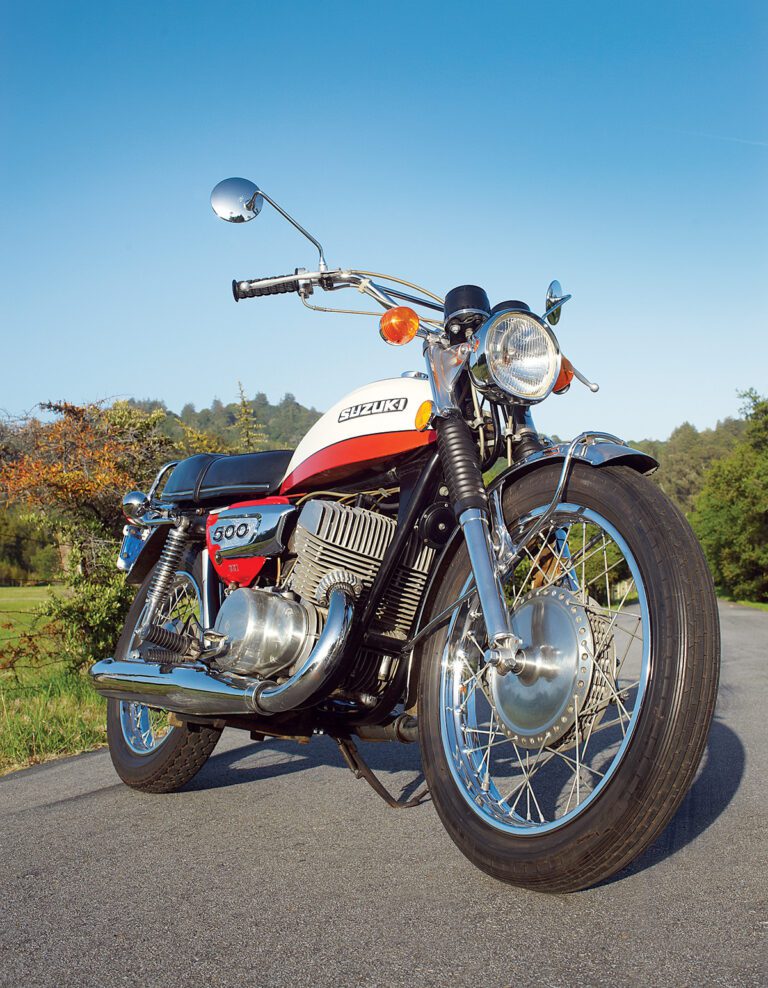
Cynics said there was no future in big 2-stroke motorcycles; the Suzuki Titan T500 proved them wrong, and it is still one of the most popular classic Japanese motorcycles.
Suzuki T500 Titan
Years produced: 1968-1976
Claimed power: 47hp @ 7,000rpm
Top speed: 105mph (observed)
Engine type: 492cc 2-stroke air-cooled parallel twin
Weight (dry): 408lb (185kg)
Price then: $899 (1970)
Price now: $1,400-$3,000
MPG: 50mpg (observed)
From the mid-Sixties to the mid-Seventies, 2-stroke motorcycles ruled the roost. Kings of the strip and the street, the young men who rode them put up with whisker-wide power bands and a massive thirst for gasoline to get that heart stopping power.
There were exceptions, however, and the exceptions to the wild Sixties 2-strokes were built by Suzuki. While other manufacturers promoted 12-second drag strip times, Suzuki focused on building reliable, user-friendly motorcycles like the Suzuki T500 Titan. Other 2-strokes screamed: Suzukis were quiet, designed for people who wanted to tour or commute, not race.

Interestingly, the technology Suzuki used to excel on the street may have come from the race track. In the early Sixties, Suzuki wanted to win races, both for the marketing advantage victory brings and to score points over rival Honda. In 1961, Suzuki made contact with Ernst Degner, a top rider and engineer with the East German MZ team. East Germany was then firmly under the heel of the Soviets, and Degner, eager to direct his destiny, seized the opportunity to get out. By the fall of 1961, Degner had made it past the Iron Curtain and was working for Suzuki.
Using the knowledge he gained working at MZ with 2-stroke guru Walter Kaaden, Degner taught Suzuki how to get real power and speed from its own 2-strokes. This knowledge was more than certainly used to improve the road machines as well as to win races, as Suzuki soon became known for its reliable and powerful 2-stroke singles and twins.
Bringing out the big guns
Late 1965, saw the introduction of the Suzuki T20, also known as the Suzuki X6 Hustler. Its 2-cylinder, 247cc engine had a bore and stroke of 54mm x 54mm, a 7.3:1 compression ratio and produced a claimed 29hp @ 7,500rpm. Pump lubrication oiled the lower end, and a six-speed gearbox transferred power to the rear wheel. Press tests confirmed the twin was good for 90mph.

A year and a half later, Suzuki took another step up and introduced a 493cc twin developed from the T20, the Suzuki T500 /Five. Honda had recently introduced the 4-stroke Honda CB450 Black Bomber, upsetting the assumption within British, European and American motorcycle circles that the Japanese were not interested in building larger capacity motorcycles. The Suzuki T500 /Five was in its own way just as revolutionary: it invalidated the belief that a large capacity 2-stroke would overheat.
The T500 /Five (500cc and five speeds), also known as the Suzuki Titan, was bombproof. Not only did it run flawlessly when contemporary magazine testers took it through Death Valley in the summertime heat, it soon gained a reputation as one of the most reliable motorcycles of the Sixties. Even so, it attracted much less attention than the Bomber, which must have irked Suzuki executives to no end. The Suzuki T500 has been called one of the most underrated motorcycles of all time.

Engine dimensions were over-square at 70mm x 64mm, similar to Suzuki’s 250 singles, and the compression ratio was 6.6:1. Cylinders were aluminum alloy sleeved with iron. The lower end had three main bearings, pump fed lubrication to the lower end of the rods and the rear of the cylinders, and alternator ignition timed by points. A 5-speed gearbox (often criticized for a “safety feature” that wouldn’t allow second to first gear shifts while on the move) transferred power to the chain final drive. The tachometer drive was taken off the countershaft, which meant the tach wouldn’t read when the clutch was disengaged.
The engine was carried in a dual-downtube steel cradle frame with wire wheels and drum brakes. Shortly after the 1968 introduction of the 500, Suzuki lengthened the swing arm just over half an inch (from 52.7 inches to 57.3 inches) to improve stability. The bike, now called the T500 Cobra, quickly gained a reputation for good handling, nicely aided by its engine’s wide power band. In 1969, the 500 was restyled and carburetor size reduced to 32mm from 34mm. “The smaller carburetors didn’t affect performance,” says Tony Silveira, owner of our feature bike. “But it really helped the gas mileage. I get 50mpg, no joke.”

Other changes included the cylinder barrels, which now had 11 fins instead of 10, new pistons and better porting. After some piston failures (most notoriously in the 1970 Cycle Big 7 Superbike Comparison), the Titan, as it was now called, was built with the stronger pistons from the water-cooled Suzuki GT750.
Cycle’s piston failure came after repeated drag strip runs. Before its engine failed, the Suzuki was basically tied with a Sportster for third best brakes in the seven bike test, and it had scored points for its light weight and bargain price. Yet it didn’t accelerate or do laps as fast as its competitors, and was, editor Cook Neilson opined, a bike “we felt might be in over its head. We were right.” Perhaps, but as the only 500 in a field of 750s one could argue the Suzuki actually acquitted itself quite well.
The world was changing, and so were Titans. After 1972, they were upstaged by the 3-cylinder, water-cooled GT750. The 1973 T500K and T500L Titans had a larger gearbox oil reservoir and a strengthened bottom end. In 1976 the bike was renamed the GT500 and given a bigger tank (4.5 gallons versus 3.7), electronic ignition and — finally — a front disc brake.

By this time, 2-stroke street bikes were reaching the end of their road. It wasn’t cost effective to clean up the emissions of even the relatively clean-running Suzuki 2-strokes, so Suzuki focused their efforts on 4-stroke engines. After an aborted (and expensive) fling with the 1975-1976 RE5 Rotary, Suzuki rolled out the Suzuki GS750 4-stroke for 1977. The last Titans were built in 1976 and offered for the 1977 year.
Fanning the fire
That Cycle shootout article might have been read by a teenage boy. Maybe one like Tony, then a kid who was falling in love with motorcycles. That kid who was crazy about motorcycles grew up and acquired a large garage, a garage he started filling with classic Japanese bikes. “I go back and look at my bikes and think of the enjoyable times I’ve had. It saves me from the stress of today’s everything,” Tony says, explaining his collection. Tony not only collects classic Japanese motorcycles, he has become knowledgeable about them to the point where he is now asked to judge at concours level events.

Tony found this Titan, a 1972 T500J, in “loved but dirty condition” some seven years ago. “It was all there, but didn’t run,” he says. To a collector concerned about authenticity, it is often most important to make sure all a bike’s hard to find parts — like sheet metal — are present and accounted for. It is usually much easier to find engine parts. “I could see that the bones were impressively nice,” Tony recalls. Importantly for Tony, his Titan has the chrome package used for one year only, 1972.
Tony does much of his own work. “I cleaned the bike first to get excited about it. The carbs were gunked up, and I cleaned the gas tank and the fuel lines and petcocks. I spent a lot of time getting anything fuel related really clean, but that wasn’t what was keeping the bike from running. It turned out to be a defective coil.”
Because the Titan was a popular bike, parts availability is relatively good. “I have found parts on eBay, Craigslist and different motorcycle sites. If you can’t find a part, Paul Miller specializes in Suzuki.”
Starting a Titan is a little different, Tony says. “The Titan is kick start only, and the kick start is on the left, which takes a little getting used to. There’s no starting procedure — you just kick until it fires, which it will do pretty quickly. It idles fine once started, but it takes a little warming up. If it feels boggy, it needs to warm up more.

“You need two types of oil for this bike, oil for the bottom end — I use Castrol 20/50 — and 2-stroke oil for the mix tank. I use synthetic 2-stroke oil,” Tony says, adding, “There’s a mix tank — Suzuki called it Posi-Force Lubrication — so you don’t have to measure oil into the gas tank. This feature started with the 1968 Cobra and was a big deal for Suzuki.”
Tony is obviously fond of this Titan. “It’s a fun, dependable bike. It’s good for little runs into town. The seat is original, with the original cover. It has lots of padding and is very comfortable. The Titan is geared high for the freeway and is a well mannered touring bike, with plenty of pulling action. It is quiet for a two stroke. It has enough weight for comfort, but it’s not like riding an elephant. The weight is low, and it does an excellent job of carrying the rider through the corners,” Tony says. “Two-strokes sometimes vibrate, but on the Titan, it’s not that irritating. Suzuki took care of a lot of the vibration by improving the engine mounts when they switched from the Cobra to the Titan models.

“This Titan’s strength is its dependability,” Tony expounds. “When I unpack the bike in spring, I take off the blankets, put gas in the tank, air in the tires and charge the battery. I kick her over a few times, the engine fires, and I am off and running again. Business as usual.” Bikes in a collection often sit, and Tony, a conscientious owner, has evolved a protocol for storing motorcycles. “Before they go to sleep in the garage, I drain the tank and the carburetors. I make sure the oil tank is full. I disassemble the fuel petcocks and soak the seals in Marvel Mystery Oil. I make sure the petcock seals are in fact sealing. Then I reassemble the petcocks and cover the bike with blankets like a baby,” he says.
When it was new, the Titan sold steadily to a loyal following. Now that it has reached classic status, Suzuki’s 500 is conserved by a small but enthusiastic group of collectors. “The classic Titan epitomizes what makes vintage Japanese motorcycles such a great ride and why I collect them,” Tony says, adding, “This Suzuki is beautiful to look at, fun to ride and super reliable. What more could I ask for!?”
Press Reports:
“For the price, the Titan is a tough package to beat. It offers performance, quality, handling, brakes and comfort.”
– Cycle Guide, April 1970
“Dollar for horsepower, money for performance, Suzuki’s 500 is formidable.”
– Cycle World, October 1970
“Needless to say, the people who said ‘it couldn’t be built’ are keeping pretty quiet these days. Not only was it built, but it has been an almost unqualified success in all respects.”
– Cycle World, October 1970
“A lot of motorcycle for the money, and as impervious to abuse as anything being made today.”
– Cycle, February 1974
“Six years ago the Titan was a revolutionary motorcycle. But the revolution has passed it by; now it is simply a solid, reliable, cheap, unexciting motorcycle that doesn’t do anything very wrong.”
– Cycle Guide, May 1974
“A God-fearing, standard-sized American can wear a Titan with comfort thanks to its soft and wide saddle.”
– Cycle, April 1976
Resources:
Read more about the motorcycles mentioned in this article:
• Suzuki X6 Hustler
• Honda CB450: The Black Bomber
• Suzuki GT750 LeMans
• 1977 Suzuki GS750