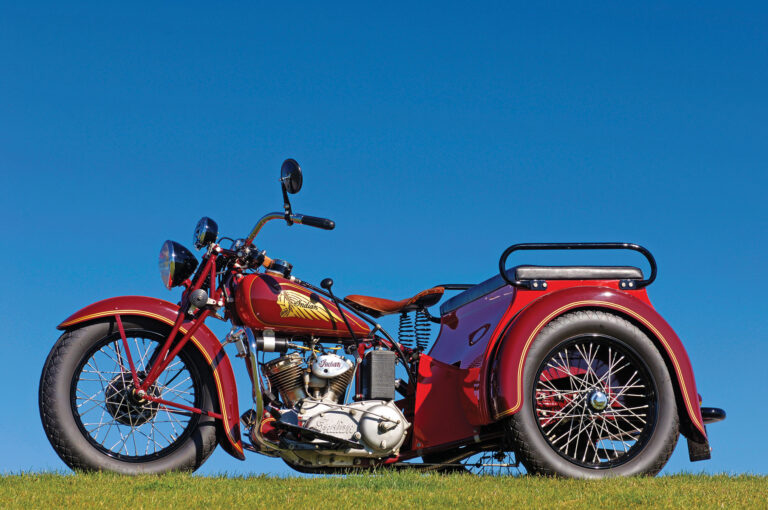
1936 Indian Dispatch-Tow

- Top speed: 65mph
- Engine: 750cc air-cooled flathead 42-degree V-twin
- Weight (wet): 500lbs (227kg) (approx.)
- Price then / now: $458 /$35,000 (est.)
When I was growing up in suburbia, most of the kids on my block had a plastic toy called a Big Wheel. There was one big wheel out front with pedals, and two much smaller wheels at the back, making it a three-wheeler. You could call the Indian Dispatch-Tow an adult Big Wheel.
A Big Wheel had a low center of gravity, and your butt sat just a few inches above the asphalt. With enough speed, you could pull off some spectacular power slides. Before there even was a Big Wheel, photographer and Indian Dispatch-Tow owner Gary Phelps built his own version. He and his friends would take a tricycle, turn the frame upside down by reversing the fork, and peel the rubber off the steel rear wheels. Then, with the upside down frame and its lower center of gravity, they’d sit on the “step” between the wheels and pull off power slides. Ah, nostalgia.

A Big Wheel or an upside down tricycle are just toys, though, and there are and were other three-wheelers out there — such as the Indian Dispatch-Tow — that were built for a much more practical purpose. Although the Dispatch-Tow is a completely different kind of three-wheeler, it also invokes a sense of nostalgia, and harkens back to a time when things might have been a bit simpler.
From the history books
According to Harry V. Sucher in his history of Indian, The Iron Redskin, the Indian Dispatch-Tow became a reality in the early 1930s, inspired by the needs of a car dealership only a few doors away from the Indian factory.
As Sucher relates it, the Dispatch-Tow was the result of discussions between Indian’s upper management and the owner of the Springfield Packard dealership. In order to provide better service to his Packard customers and reduce wasted time and money, the dealer wanted to find a simple way of ferrying customer cars back and forth from the customer’s home to the garage. He was tired of sending two men in one car, only to have them both come back to the garage, to be sent back out again after the repairs were made. Fact or fiction, it’s hard to know.

Apparently, Indian took the need seriously, because top designer Charles Franklin drew plans for a three-wheeled vehicle based on the popular Indian 101 Scout chassis, fitted with either a 37-cubic-inch or an optional 45-cubic-inch V-twin engine.
An automotive-style rear axle, complete with a differential, was rigidly mounted at the back of the machine. Two wheels flanked a sheet metal box, and this was supported on a single leaf spring and shackle set up. It was this box that gave the Dispatch-Tow its unique lines. Of course, a three-wheeled machine isn’t likely to tip over, which gave Franklin the opportunity to design a tow bar that, when attached to the front of the Dispatch-Tow, could be quickly and conveniently flipped down and attached to the rear bumper of a car.

That meant an employee of an automobile dealership could ride the Indian Dispatch-Tow to a customer’s location, affix the tow bar to the car and drive the whole rig back to the garage for service, and then repeat the routine. This proved advantageous, of course, because it tied up only one employee.
Official announcement
Indian’s Contact Points No. 426, dated April 28, 1931, includes the first announcement of the Dispatch-Tow, along with another three-wheeled unit, the Dispatch-Car. Contact Points was a newsletter from the factory to the dealer, and in the document Indian espouses the selling points of their new three-wheeler.
“The Indian Dispatch-Tow has been designed and developed to meet a crying need in the automobile field. The demand for this vehicle already exists, and is making itself more evident every day,” the newsletter proclaimed. “Successful automobile dealers, service organizations and garages know and appreciate the value of giving quick service to car owners. More and more — the car owner is demanding that the service man call at his home or office for his car, take it to the service station for the work done and then return it. This means sending two men and one automobile to bring in the customer’s car.”

Following its introduction, the Dispatch-Tow found immediate favor, and some 400 units were sold. Yet Indian seems to have only built the Dispatch-Tow for that single year. In 1932, Indian replaced the 101 Scout with the Standard Scout — essentially a 45-cubic-inch Scout engine in a larger Chief frame. With this change it appears no more Dispatch-Tow machines were built until 1935, going by the model data and serial numbers presented at on the Indian Motorcycle website. This is reinforced in Sucher’s The Iron Redskin. After discussing various other models noted for 1935, he states: “The Dispatch-Tow, which had been discontinued in 1932 with the demise of the 101, was resurrected with the Sport Scout, which for this use was fitted with a low compression commercial-type engine and lowered gear ratios. Two models were featured, one with a standard-sized body and another with an optional oversized box of enhanced carrying capacity.”

However, there’s a wrench to be thrown into the works. In Contact Points No. 444, May 18, 1933, there appears an image of a Dispatch-Tow on the cover, with the text: “The New Indian Dispatch-Tow – Full Sprung Body – Two Body Styles – New Low Price.” The box work is different from the 1931 model, and it is fitted with a girder fork as opposed to the leaf spring unit on the earlier model. In this particular newsletter the prices have been blacked out, leading to speculation that perhaps this was only a prototype unit, as there is no further mention of a Dispatch-Tow in an issue of Contact Points until 1935. Regardless, Indian didn’t have the three-wheel market cornered. Harley-Davidson entered on the scene in 1932 with the Harley-Davidson Servi-Car, a unit similar in theory to the Dispatch-Tow.
Both the Dispatch-Tow and Servi-Car soon found favor with users other than automobile dealerships and service stations. As a utility vehicle, the three-wheelers were put to a variety of tasks, and with their panel work, a painted sign was sure to draw attention. Whether it was a police force or a drugstore, the three-wheelers were put to work.
Bud and Gary’s Dispatch-Tow
It was the ease of use that first drew Gary Phelps and his father, Bud, to this 1936 Indian Dispatch-Tow. Gary and Bud have long been interested in motorcycles, and Bud was riding a 1933 Indian Four when the pair found this bike.
“The reason we went to the Dispatch-Tow is the Four became a bit too much for dad as he got older,” Gary says from his California home. “This Dispatch-Tow became available, and I asked him what he thought about having three wheels. He liked the idea, but it had to be an Indian.” Gary found the Dispatch-Tow at The Shop, a motorcycle shop in Ventura, Calif., that deals in vintage American motorcycles.

David Hansen, a long-time friend of Gary’s, owns The Shop. In fact, Gary credits David for getting him interested in old motorcycles in the first place — which happened back in 1979. Gary was a photographer for the Ventura County Star, and because of his enthusiasm for motorcycles, he stopped in at The Shop and introduced himself to David. What followed was a story for the newspaper about the history of American motorcycles — and a friendship.
For quite some time Gary had been aware of this particular Dispatch-Tow, and at one point in the early 1980s he watched as a couple of his friends worked at getting it running. David had actually owned the outfit before them, bought it back, kept it, and then sold it to Gary. While resurrected to the point where it could be ridden, the Indian was far from perfect.
When Gary and his dad dragged the machine home in 1994, it was finished in a chipped and scratched coat of gloss black paint. It had a homemade, open-style truck box, plus the wrong fork, front fender, chain guard, handlebar, ignition switch, horn and front frame section. Gary says about the only items that were correct were the engine, gas tanks, wheels, brakes, rear frame section and the rear axle. Luckily, they didn’t have to search for a Dispatch-Tow box, as the project came with a faithful reproduction of an original. Yet the Indian ran, and ran well, so Bud rode it while the pair began acquiring many of the correct components.

Gary and Bud performed a rolling restoration on the Indian. Every time a correct component was obtained — like the front fender — it was cleaned up, treated to a coat of primer, and installed. They replaced the 1937 front frame section with the proper 1936 item, and Gary traded the incorrect fork for the correct item. By far the most difficult part of the build was mounting the rear box and getting the proper shackles and spring. Gary borrowed the parts that support the box from David — who happened to have a complete Dispatch-Tow for reference — and turned to a local foundry to reproduce the spring components.
Ready to restore
It took four years to locate all of the correct items, and in 1998 they stripped down the Indian for painting and plating. Bud and Gary took the opportunity to lift the heads and jugs on the 45-cubic-inch engine, and discovered the bottom end was still very tight. They cleaned and reassembled the engine, replacing worn components where necessary. The gearbox and differential were taken apart and inspected, and found to be in very good repair.

Bud chose the Indian Red and Chinese Red (it’s almost orange) two-tone color scheme. The DuPont family owned Indian in the 1930s, and with the connection to DuPont paints, an Indian machine could be had in an array of colors — usually at an extra cost to the purchaser. “At some point my dad started complaining about how much this was costing,” Gary says, “and I told him, ‘You’re only spending my inheritance, just go for it.'”
Their Dispatch-Tow saw more miles before it was completely restored, as it had now become something of a showpiece, what with the fresh paint and plating. Bud rode it on a few Indian runs, but now 86, he no longer rides at all, and Gary is the caretaker of the Dispatch-Tow. He fires it up occasionally and takes it for a spin around town, and when he parks it the Indian always draws a crowd. This Dispatch-Tow was the only machine father and son dedicated themselves to restoring as a team, and there’s tremendous value in that for both of them.
The end of an era
Indian carried on sales of the classically configured Dispatch-Tow into 1942, when production of the utility vehicles stopped. Between 1950 and 1952 three-wheel machines were built again, mainly for police departments, and were dubbed “Patrol” models. These were based on the 80-cubic-inch Chief, 45-cubic-inch Scout or 30.5-cubic-inch Warrior. After the demise of Indian proper in 1953 there was an Indian-badged Royal Enfield-powered three-wheeler built by Pashley of the U.K., and available one year only in 1959. It was known simply as the Patrol Car.
Interestingly, three-wheelers seem to be gaining in popularity today, with machines like Lehman trikes and Can-Am Spyders all the rage. Harley-Davidson is once again offering a three-wheeler, and even the plastic Big Wheel is back in production. But the age of sending a man out to pick up a car and bring it back to the garage is long over. MC