


Honda CX650 Turbo
Years produced: 1983
Claimed power: 100hp @ 8,000rpm
Top speed: 140.4mph (period test)
Engine type: 674cc OHV, turbo-charged, liquid-cooled 80-degree V-twin
Weight (wet): 260.5kg (573lb)
Price then: $4,998
Price now: $4,000-$6,000
MPG: 45.8mpg (period test)
In 1983, turbocharging was the wave of the motorcycle future. And while the Honda CX650 Turbo was arguably the best of the turbocharged motorcycles that roared onto roads in the early Eighties, it is now one of the rarest production Hondas ever, with only 1,777 built and fewer than 1,200 imported to the U.S. and Canada.
Remember the late 1970s? Relatively high gas prices combined with general affluence spawned a large market for motorcycles, especially middleweight bikes that could be used to get to work or school and for short distance touring. Motorcyclists were generally younger than they are now, and interested in power, speed, and the new and the different.
But there were clouds on the horizon. Growing concern about pollution and safety had governments increasingly regulating motor vehicles; but we weren’t too worried. Technology was king, and we thought technology would give us socially conscious but exciting motorcycles — bikes that were quiet but still an absolute thrill to ride. Bikes that, despite being pollution free, would blast past everything on the road.
Looking for the new dawn
Although Honda was the world’s largest motorcycle manufacturer in the 1970s, the company was very conscious of competitors breathing down its neck, and it was looking for ways to stay ahead of the pack. One way to do this was to stay ahead of the technological curve.
In 1978, Honda introduced the CX500, a bike it said was designed to be quiet, efficient, low emission and maintenance free. In fact, when the CX500 was first conceived, it was intended to appeal to women. The CX had a 4-valve-per-cylinder, pushrod operated V-twin engine, shaft drive, a 5-speed gearbox, water cooling and Honda’s new ComStar wheels shod with tubeless tires — the first tubeless tires designed for a production motorcycle.
Although the CX500 wasn’t particularly exciting to ride, it proved (after a cam chain tensioner glitch was ironed out) to be reliable and user friendly. It sold well, especially in Europe, where tax and licensing laws encouraged people to buy smaller bikes, and it became the favorite mount of British motorcycle couriers for many years.
Honda, however, wanted to show it could do more than simply build user-friendly, durable motorcycles. Its engineers, conscious of the need for innovation, thought the CX might be used as a platform for something more exciting. After some experiments with supercharging, they came up with the idea of turbocharging the CX. A turbocharger significantly increases engine performance without adding a lot of weight, and at first glance it seemed an ideal way to increase performance.
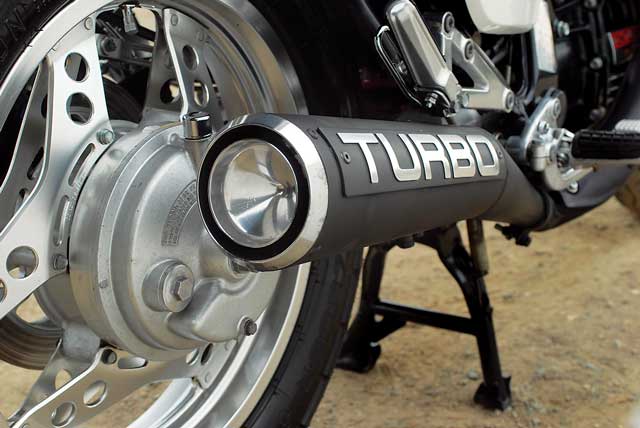
Basically a mini turbine, a turbocharger is powered by the engine’s own exhaust gases. Exhaust gases flowing through the turbo turn a small rotor, which in turn drives another rotor to deliver air under pressure to the intake manifold. This creates a denser air charge, allowing a larger fuel/air charge in each cylinder, and hence more power. The challenge is making the extra boost of power easily controllable. As one contemporary writer said about the Honda CX650T, “The power comes on so suddenly that you’d best be pointed in the desired direction, because THAT is where you’ll be heading with great alacrity.”
Art Friedman, then editor of Motorcyclist, says research showed a demand for turbos: “The riding public anticipated motorcycles that had the weight and response of a middleweight with the power of a liter bike, at a price that was somewhere in between. There was a lot of excitement around them.”
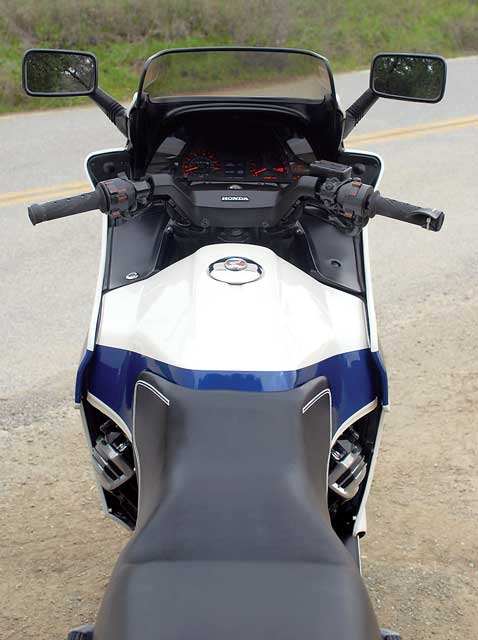
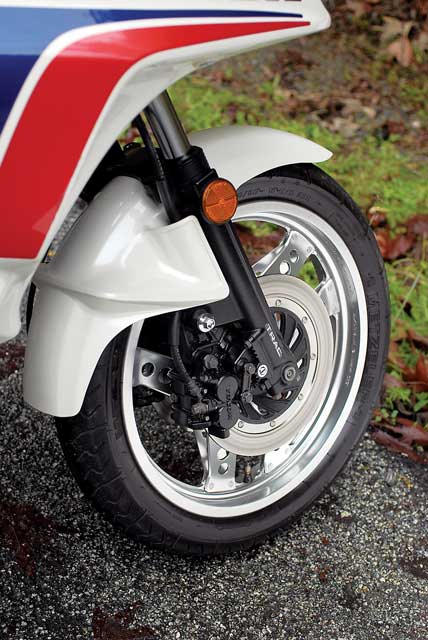
The first Honda turbo, the CX500TC, was announced in 1981 and appeared in 1982. It not only sported a turbocharger, but also a complex fuel injection system and a pair of onboard computers. Like all CXs, the engine was a stressed member of the frame, while the chassis sported an integrated fairing, a huge headlight, dual disc brakes in front and a single disc in the rear.
Yet despite Honda’s best efforts, bugs remained. Period testers found that, although the CX500 Turbo was blindingly fast on boost, easily reaching 125mph, it was expensive, thirsty and suffered from a phenomenon known as turbo lag, meaning it would hesitate before the turbo spooled up and sent it lunging ahead. Getting a CX500 around a set of twisties could be challenging.
Honda went back to the drawing board and came up with the CX650T for the 1983 model year. The engine was bumped up to 674cc and the compression ratio increased from 7.2:1 to 7.8:1. The computer controls were simplified and the gearing ratios were adjusted, with a wider gap between fourth and fifth. The result was a bike that, while equally impressive on boost, was a lot easier to ride when transitioning from off-boost to on-boost.
Riding the boost
Period testers and Ron Graf, the owner of our feature bike, agree that the turbo is at its best on secondary country roads with broad sweeping turns. “I was coming up [California] Highway 9 in front of a Kawasaki or Yamaha 1100,” Ron remembers. “I was letting it rip coming out of the corners. I came to a crossroads and parked the bike. The guy on the 1100 came running up to me, ‘What is it?’ he demanded. ‘You have this skinny rear tire and I couldn’t keep up with you!'”
Read Ron Graf’s experience owning and riding a 1983 Honda CX500 Turbo
A Honda CX650 Turbo is not at its best when the road really narrows, however. Period testers found the bike’s high center of gravity and 573-pound wet weight made for a lot of work switch-backing up mountain roads.
Where the CX Turbo works best is as a sporty touring bike. The seat and riding position are comfortable for average-sized riders, and the curb weight is actually 11 pounds lighter than the predecessor 500. The single rear shock has a damping adjustment lever that is reachable from the seat, vibration is mild, and the fairing shields the average-sized rider nicely.
The Turbo’s problems could probably have been worked out but for the economic situation. In 1981, worldwide motorcycle sales had been very good. Honda had actually sold out of some models, and Yamaha had outsold Honda for one month. In 1982, both companies brought out new models and shipped large quantities of them to the U.S.
But in 1983, the bottom dropped out of the economy, and people stopped buying motorcycles. To make matters worse for Japanese importers, Harley-Davidson successfully petitioned for a tariff on all Japanese imports of 700cc and larger.
The U.S. economy got going again in 1984 and 1985, but motorcycle sales stayed slow. It made no sense to continue to produce any but the most popular models, so the CX650T was taken out of production.
“In the end, turbos vanished because they didn’t meet buyers’ expectations,” explains Art Friedman. “The fantasy of middleweight handling and cost with big-bike power turned out to be bikes with difficult power characteristics that weighed and cost nearly as much as the big bikes, and generally didn’t perform as well. In addition, the plunge in sales that lasted through the 1980s meant that only the strong would survive.”
CX650 Turbo maintenance tips
Most Hondas are reliable bikes, needing minimal maintenance. Not the Turbo. “Either be willing to spend money on repairs or learn to like working on the bike,” says Ron Graf.
For example, the stock alternator tends to burn out at 15,000 to 20,000 miles. The alternator is on the backside of the engine, which is a stressed member of the frame. Getting to the alternator requires removing the engine, then replacing the stock unit with an Electrex stator, which soldiers on indefinitely. The stock starter motor also often goes bad, which causes other problems. “The stock starter motor draws too much current,” Ron explains. “The engine kicks back and breaks the starter clutch springs. The starter clutch rollers grind on the crankshaft, and you can hear the grinding noise when you start the bike up. Don’t let it go — you will find yourself without a bottom end. The solution is any CX500 starter motor with four Phillips head screws in the center. This type of starter motor fits, and again, it is a permanent fix.”
The tech school bikes
When Honda engineered the Turbo, the company was concerned that dealerships wouldn’t know how to work on them. According to information in Turbo News and On Boost newsletters, derived from an unnamed former Honda employee, of the approximately 1,200 CX650 Turbos imported into the U.S. and Canada, half supposedly went to Honda tech schools and junior college mechanics programs. Honda specified in the donation agreement that tech school bikes were not supposed to leave the school, and the instructors were supposed to destroy them after the model was discontinued.
Supposedly, a lot of the tech school Turbos leaked out into the marketplace. “Some people have actually purchased bikes directly from a school for an insanely low price,” Ron explains. “As far as I know, these sources have dried up, but no one ever knows what lurks in the tech school basement.” Why so many “school” bikes? If true, it would suggest Honda had long-term plans for the CX650T, plans that were quietly shelved when the bike failed to deliver a market.
Press reports
“The problem with the CX-T is that it’s impossible to resist constantly dipping into the boost. And anytime you light up the boost gauge on this bike, speed limits become a joke.”
— Cycle Guide, March 1983
“The Honda’s huge power surge is breathtakingly fun, and reduced turbo lag makes the 650 a joy to ride fast.”
— Cycle, October 1983
“The CX650T is a splendid touring bike, and its fear-inducing mid-range power elevates it to Grand Touring status.”
— Cycle, October 1983
“Off boost, the CX650T chuffs its way down the road like a mildly tuned 650 twin. On boost, it accelerates like an F-4 being blasted off the flight deck of the USS Enterprise by a steam catapult.”
— Rider, October 1983
“The Honda seems to glide effortlessly down the road at high speeds, the subdued whir of its turbocharger the only hint that this bike is pressure fed.”
— Rider, October 1983
“The bike would fling itself forward, turbocharger whistling, and you could easily mistake the blur of passing scenery for the blur of a Doppler shift as you reached terminal velocity.”
— Cycle World, January 1987
Resources
• Dutch Honda First Turbo Club
• Turbo Owners Assoc.
Parts
• www.BikeBandit.com
CXTC’s Parts & Accessories, Inc.
• turbodan55@gmail.com