Triumph Quadrant Special
- Claimed power: 75hp @ 7,250rpm
- Top speed: 125mph
- Engine: 987cc OHV, air-cooled inline four
- Weight (dry): 261kg (575lb) (est.)
- Fuel capacity/MPG: 22ltr/25mpg(est.)
The 4-cylinder Triumph Quadrant prototype put together at Triumph’s development shop in Kitts Green, Birmingham, England, in the 1970s under the leadership of Doug Hele is well documented. That it never reached production to take on the might of the Japanese multis is something now consigned to the history books. But why talk about “if only” when you can build your own?
If you’ve ever carried out a restoration or customizing project, you can identify with all of the frustrations and setbacks that come along with getting even the most humble machine running and roadworthy again.
If you’ve ever faced a box full of gleaming new paintwork and glistening chrome, only to realize the notes you made when you stripped it all down are less than comprehensive or the wiring is now strangely unfathomable, then you know exactly what I’m talking about. For some people, of course, the challenge of just restoring a machine isn’t enough, so they go several steps further to create an original machine. George Pooley is one of those people.
First sight
I first saw George’s impressive Triumph Quadrant Special at the 2005 International Classic Motorcycle Show in Staffordshire, England, where it took home the trophy for the best classic special, and I was delighted when George invited me to take it for a ride. It probably doesn’t come as a surprise to learn that, having previously owned six triples, George is both a fountain of knowledge on Triumph triples and a highly accomplished engineer. The Triumph Quadrant (rhymes with Trident) is not the first special to come from George’s well-equipped workshop. In 1993, the same show saw the debut of a 1,500cc Triumph six. This was an amazing concoction featuring the top end from two T160 triples joined together in a common crankcase to form a V6. Along with several other embryonic projects, the Triumph six still resides in his workshop.

As the thousands of show goers who admired the Triumph Quadrant at the Stafford show will testify, it looks anything but a “backyard special,” and is testimony to the quality of George’s workmanship. A working career that started as an under-paid apprentice engineer in 1969 was followed soon afterward by his first motorcycle, a Royal Enfield Clipper. The association with the Enfield gave George an insight into the mechanical side of motorcycling, though he quickly had his sights set on something sportier.
“I’d always hankered after a BSA Super Rocket, and in the early 1970s bought one for £25 [about $60 U.S.], which even in those days was a bit of a bargain,” says George. “By the time I’d finished my apprenticeship I was on better money, so it was then that I got my first Triumph, a T120, closely followed by a T140. The ‘Bonnie’ got nicked, so with the insurance payout I bought my first triple, which was a 1969 T150.” That first 3-cylinder was the start of a love affair with Triumph triples that has now lasted more than 30 years. And despite the ups and downs that occur in any long-term relationship, this one shows no sign of cooling.
Beginnings of the Triumph Quadrant engine
Given George’s engineering background, I fully expected to be presented with a plethora of detailed technical drawings and calculations done before the beginnings of the build, but it seems most of George’s ideas are carried in his head and the rest worked out on the back of old envelopes.
“After making the six I had several projects in mind, but it wasn’t until I saw the original Triumph Quadrant that I got to thinking about building one of my own,” recalls George. “I find the forward canted engine of the T160 aesthetically much more pleasing than the bolt upright T150, and as I’ve owned several of the electric start models I had a ready source of components to begin with. As the project went on, I sourced other bits and pieces through my contacts in the Trident and Rocket 3 Owners Club and also through swap meets.

“I started with the crankshaft, which I made from solid billet. I needed to work out the details of the other two extra journals that were required, which I did by taking the average measurement of three triple cranks. Needless to say, they were all slightly different from one another! I turned and milled the crank myself. Dave Beastall drilled the oil ways and made the splines and threads. With this done I then had the crank normalized, nitrided, and fitted the rods and pistons. Incidentally, the finished weight of the crank was nearly 40 pounds.”
Throughout the project George received help from many sources, but he singles out Dave Smith, John Revill and Dave Beastall for special recognition and thanks. It would seem that Triumph’s plans to make a full-blown production engine were fairly advanced, and through his many contacts George managed to get a set of camshafts that had been made by Triumph and Norton specialist Norman Hyde’s father, Roy, in the early Seventies. These were unhardened, but after 72 hours of nitriding they were ready for installation.

Installing into what, you ask? Making up the crankcases and modifying the barrels and rocker boxes called for a lot of cutting and welding. “I machined approximately 1 inch of a second center crankcase. John made a mandrel for the mains and Dave Beastall made two for the camshafts to line the crankcases up. With this completed, Dave Smith then welded these together and, amazingly, everything spun OK. To make it into a four, I’d cut one cylinder off two sets of barrels and heads, and four sections off four rocker boxes and covers. These were machined by John and me while Dave Smith dealt with the welding. In addition, I modified four rocker shafts and rearranged the rockers to suit,” George says. The matter-of-fact way that George describes everything disguises the huge amount of time and skill this part of the project took to complete.
From an engineering point of view, it would have been easier to revert to a right hand gear change. But George decided that aesthetics ruled and he would retain it on the left. This involved more welding to the timing side crankcase and gearbox inner and outer, which he and John then machined offset from the standard setup. The timing cover ignition plate holes were also welded up and repositioned to accept two much-modified Boyer Bransden electronic ignition units.
Framing creativity
Unlike the original Kitts Green Quadrant, which utilized a frame destined for the stillborn OHC BSA triple, George decided to use a modified T120 frame. Accommodating the 4-cylinder engine involved creating a wider cradle and front engine plate mountings, and while he was at it he brought the swingarm bracket up to T160 spec by raising it 1 inch.

For everything to line up, he moved the engine to the left by 1 inch, but this left the kickstarter fouling the oil tank, so a further modification was required. This involved manufacturing a longer shaft and a second gearbox outer cover that was cut and welded to the original, thus allowing the kickstarter to miss the oil tank. Having already made the decision to use a rather fat 5.10 x 16-inch rear tire, he widened the swingarm along with extended shock absorber brackets on the T160 subframe. At the front, the original 19-inch rim was discarded in favor of an 18-incher.
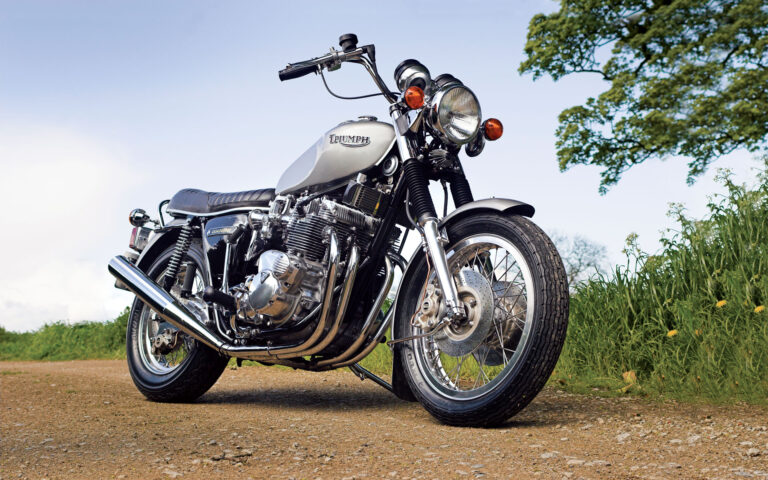
Looking at the bike, you’re immediately drawn to the bank of four bell-mouthed Amal concentric carburetors and their swooping inlet manifolds. These were all made by George, and after machining, were heated and bent until they cleared the underside of the gas tank. The carb linkage was made from an amalgam of T150 and T160 parts, and was welded together by Dave Smith.
Especially stock
The bike looks anything but a special and abounds with George’s neat touches and painstaking attention to detail. Many parts were fabricated from stainless steel, including the cover for the electric starter, the oil-cooler mounting brackets and the end caps for the swingarm.
To retain an early 1970s look, both fenders lost their chrome and, along with the gas tank and chain guard, were sprayed in deep silver. With the finished engine mounted in the frame there was a 2-inch overhang to the right, but this only becomes apparent if you happen to notice that exhaust pipe No. 3 is closer to the frame than that of No. 2. The whole exhaust manifold and downpipe system was fabricated by George and John from a standard set up. It exits neatly into a pair of nicely angled Triumph “black cap” mufflers.
Up and running
The all important first start up came on July 21, 2004, but the inaugural run had to be put on hold while George dealt with ignition problems and a misbehaving carb. By September this was cured, and the bike made its first public appearance. This was limited to a short and gentle ride around the English countryside, but despite an oil leak from the center barrels it quickly showed the machine’s undoubted potential. At 70mph it wafted along at a leisurely 3,000rpm.
With a mere 160 miles showing on the clock and nervously aware that I was about to ride a unique machine, it was time for me to sample George’s amazing creation. The original T160 electric start has been retained, but is still undergoing improvements, so it’s down to the good old-fashioned kickstarter to fire the Triumph Quadrant up. The tickler on the inboard Amal carb is not easily accessible, but following some copious flooding of the other three a hearty lunge soon saw the 1,000cc four burst into life.

The exhaust note has a deep, soulful rumble, and is not very different from that of a Seventies Japanese 4-cylinder that has been allowed to breathe: It’s healthy sounding without being anti-social. Before moving off, George warned me to be careful with slow-speed maneuvers, where the extra weight on the right is most noticeable. With this in mind I engaged first gear and made my way out onto the main road.
Triumph’s car-type diaphragm clutch has a reputation for a lot of initial travel before taking up drive almost instantly, but here the Quadrant was silky smooth in operation. Mindful that I was aboard a one-off machine, I was not about to indulge in testing for optimum performance or handling, but even on a whiff of throttle I found myself bowling along at around 70mph. George has opted for a pair of U.S.-spec high-rise handle bars, which blend in nicely with the overall style of the bike and make direction changes easy.

Once on the move there was no sign of the extra weight on the right, and despite the fat 5.10 rear tire, which you’d expect to make the steering much slower, the overall handling was a revelation. Through a series of bends it was easy to flick the bike from side to side, and it held its line in rock-steady fashion. Due to the extra overall weight, the initial proving run had shown shortcomings in the front forks, which bottomed under braking. This was cured by fitting 1-inch longer springs and using thicker oil. Stock twin shocks support the rear. The impressive braking is taken care of by standard T160 triple discs that George skimmed and drilled. Here again, more neat detail finishes include copper brake lines and stainless brackets and fasteners.
As the test continued, the engine lost its crisp edge and started to cough and run rich on one cylinder. Out of reverence we decided to call it a day and returned to George’s workshop. It all pointed to a bad spark plug or possibly a sticking float, but with these two options proving to be negative it was time for me to leave George to further probing. He telephoned the next day to report that the hiccup was caused by a magnet on the electronic ignition that had separated from the rotor, and that it was again running sweetly.
Troubles such as this are to be expected with a bike so heavily modified. Even from my short run, it was obvious that George’s Triumph Quadrant is a very impressive piece of machinery, a great credit to its creator. That Triumph’s own Quadrant never reached production is something to be lamented, but thanks to the vision and skill of George Pooley, a tantalizing glimpse of what might have been lives on. MC