Harley-Davidson XLCR
- Claimed power: 61/68hp @ 6,200rpm (claimed) 44rwhp @ 5,500rpm (measured)
- Top speed: 106mph (period test)
- Engine: 997cc air-cooled, OHV 45-degree V-twin 4-stroke, 81mm x 96.8mm bore and stroke, 9:1 compression
- Weight (curb), half tank fuel: 515lb/234kg (period test)
- Fuel capacity/MPG: 4gal (15ltr) /44mpg
- Price then/now: $3,595 (1977) /$7,000-$25,000
“Sell the sizzle, not the steak,” they say on Madison Avenue. By 1977, the Harley-Davidson Sportster still had plenty of beef, but the grill was running low on gas. What to do?
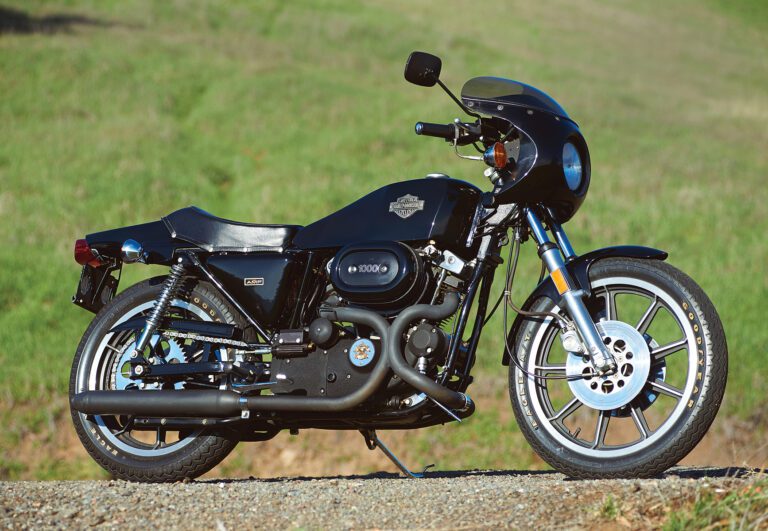
As he had with the 1971 Super Glide, H-D styling guru Willie G. Davidson caught the zeitgeist: his team took the 997cc Sportster, reached into the Juneau Avenue parts bin, added blacked-out fiberglass bodywork and incorporated virtuoso exhaust headers — still the most distinctive styling touch on the XLCR. The sizzle became a three-alarm blaze!
The XL Café Racer was, underneath the fancy dress, just an iron-head Sportster. But the dress-up was quite impressive. Willie G. chose lines that echoed the Fastback Norton Commando but with distinctive angularity, then added a handlebar fairing. The finish was basic black, with minimal polished alloy and chrome.
The powerplant was the familiar air-cooled, 4-cam OHV 45-degree V-twin with exposed pushrod tubes, iron cylinder and head, and constructed in-unit with the transmission. A 38mm Keihin carb provided the gas. The single-crankpin, long-stroke mill powered a 4-speed transmission with all-chain drive. The chassis was straight from the Sportster, but with a new rear section and swingarm based on the XR750. Thus, to fit the dual preload-adjustable Gabriel shocks, the pivot moved behind the rear axle, limiting suspension travel. The Showa front fork also came from the Sportster, and the chassis rolled on 19/18-inch Morris cast alloy wheels, slowed with Kelsey-Hayes triple disc brakes.
With around 44 horsepower on Cycle Guide’s dyno, the XLCR was no rocket ship, although its lower gearing and a small power boost from the siamesed exhaust helped it make sub-13 second quarter-mile runs — just. Handling was fine, within limits. “… not nearly as clumsy at low speeds as one would expect,” though “fast sweepers at a constant speed are where the CR works best,” said Cycle World.
Most criticism was aimed at the user interface: the suspension was “jarring” with just two inches of rear travel; the controls were heavy and awkward; the seat too small and narrow, said Cycle Guide, and the brakes were “poor.” And, of course, there was vibration … though less intrusive than the Sportster’s. Cycle World’s tester liked the riding position, however: “Swing aboard the CR and drop into the café crouch, and it works better than one would suspect.” “The bars are bent almost perfectly … better than the styled bars of the normal Sportster,” noting that the rearset footpegs put the rider in the comfiest part of the seat.
Cycle World’s Peter Egan wrote in his Leanings column: “This bike is me.” Riding the CR, he found it “surprisingly more comfortable and pleasant than legend had intimated, with wonderful gobs of midrange torque and locomotive-like clout in fourth (top) gear.” The engine was “crude but exciting,” he wrote.
XLCR in context
But the XLCR wasn’t really about performance, practicality or even presence, though it had plenty of the last: it became a showcase to pull potential buyers into showrooms — where they would more likely buy an Electra Glide.
What H-D did produce was a statement of potential without having to develop and build a new bike. Unfortunately, it also highlighted the crude and dated drivetrain. Then how do anachronism and obsolescence become heritage and tradition? Can nostalgia overcome antiquated engineering? And if so, when does a clunker become a classic?
Wrote Peter Egan: “If the Harley Café Racer was a little elemental and old-fashioned in 1977, its shortcomings gradually seem less important with the passage of time … there are legions of newer bikes that are far better than any of the XLCR’s competition from 1977.”
“Take away those period comparisons, and all you have left is a charismatic vintage bike that is beautiful to look at and exciting to ride, even now. Willie G’s Café Racer may have finally reached that magical age where a bike no longer needs to be better than some other venerable thing to justify itself. It only has to move the soul.” MC
Two more big bore bruisers
1974-1976 BMW R90S

BMW’s 1976 R90S was intended to create a sportier image for the company — and it did. Steve McLaughlin won the opening round of the new AMA Superbike series at Daytona in 1976 with Reg Pridmore second, both riding R90S-based bikes. The 1976 championship went to Pridmore. The S was the first big street bike with a fairing and twin disc brakes and also boasted a hand-applied custom paint job. It sold 17,000 over a three-year production run, despite being almost twice the price of a Honda 750.
The S spec included dual 38mm Dell’Orto carbs and higher compression — 9.5:1 instead of 9:1, giving seven extra ponies over the R90/6’s 60 horsepower. And though the S lacked the outright power of its Japanese contemporaries, it would walk away from many, including Kawasaki’s Z1, in roll-on tests.
It was perhaps a prototypical sport-tourer rather than sport bike or superbike: 100mph-plus cruising was not only possible but also pleasurable. It was, said Cycle magazine “… lavishly endowed with quality and the kind of performance that makes you wonder why everyone has to travel so slow.”
- Claimed power: 67hp @ 7,000rpm (claimed) 48rwhp @7,000rpm (measured)
- Top speed: 123mph (period test)
- Engine: 898cc air-cooled, OHV flat-twin 4-stroke, 90mm x 70.6mm bore and stroke, 9.5:1 compression
- Weight (curb): 486lb (220kg)
- Fuel capacity/MPG: 6.3gal (24ltr)/45mpg
- Price then/now: $3,430 (1974)/ $6,000-$15,000
1976-1978 Moto Guzzi 850 Le Mans Mk1

Guzzi’s V7 of 1971 combined Giulio Cesare Carcano’s transverse V-twin with a sleek new frame by Lino Tonti. The resulting V7 Sport was a fast lightweight in the 750 class. For the 850 Le Mans, the V7 engine gained a longer stroke for 844cc.
The Le Mans used high-compression pistons running in chrome-plated alloy barrels, larger valves, new camshaft and two 36mm Dell’Orto carbs. Brembo calipers gripped the twin drilled cast-iron front brake discs, one of which was linked to the rear disc through the brake pedal.
The styling was sporty, with clipon bars, rearset footrests, a cockpit fairing and a humped seat. At 71 horsepower and 124mph (when introduced in 1976) it may not have been fastest in a straight line, but it compensated with nimble handling and straight-line stability. Deservedly respected in its day and still very usable in modern highway conditions, the Moto Guzzi 850 Le Mans Mk1 is a true classic that has justifiably acquired cult status.
- Claimed power: 71hp @ 7,300rpm (claimed)
- Top speed: 132mph
- Engine: 844cc air-cooled, OHV 90-degree transverse V-twin 4-stroke, 83mm x 78mm bore and stroke, 10.2:1 compression
- Weight (curb, full tank): 531lb (241kg)
- Fuel capacity/MPG: 5.9gal(22.3ltr)/34mpg
- Price then/now: $3,679 (1977)/ $6,000-$20,000