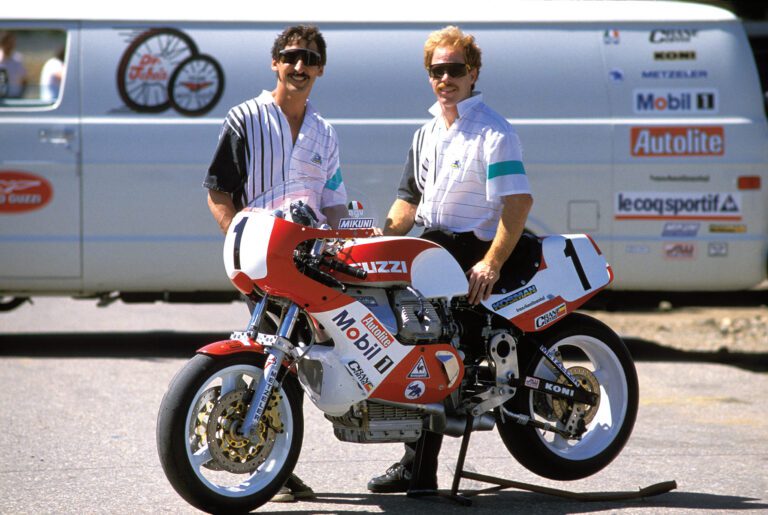
Moto Guzzi 1000R 4-Valve
Engine: 999cc air-cooled SOHC transverse 90-degree V-twin, 4 valves per cylinder, 95.25mm x 70mm bore and stroke, 11.25:1 compression ratio, 115hp @ 9,300rpm
Top speed: 166mph (Daytona 1989)
Carburetion: Two 41.5mm flat-slide Mikuni
Transmission: 5-speed, shaft final drive
Electrics: 12v, Dyna S/Raceco electronic CDI
Frame/wheelbase: Chrome-moly square-section backbone frame with aluminum side plates/57.5in (1,460mm)
Suspension: Telescopic front forks with single centrally mounted fully adjustable Koni F1 shock, box-section steel cantilever monoshock rear with fully adjustable Koni F1 shock
Brakes: Dual 11.8in (300mm) Brembo floating cast iron discs front, single 9in (230mm) Brembo floating cast iron disc rear
Tires: 120/70 x 17in front, 170/55 x 17in rear
Weight: 347lb (158kg) with oil, no fuel
Thirty years ago in 1988, Moto Guzzi’s hi-cam, 4-valve-per-cylinder engine made its public debut in the U.S. Battle of the Twins competition, finally reaching production for customer sale in 1992. The saga of American dentist Dr. John Wittner and his Moto Guzzi racers is a motorcycling fairy tale that put the mercurial Italo-Argentinian Alejandro De Tomaso, then owner of Moto Guzzi, in the unlikely role of a fairy godfather.
In his spare time from dentistry, Wittner had played with tuning Harley-Davidson engines, mainly for road racing around the northeast. But in 1983 he decided to buy a Moto Guzzi Le Mans, if for no other reason than he thought it looked neat, and also had a pushrod engine like the Harleys he was used to. Trained as a mechanical engineer before taking up dentistry, Wittner appreciated the Guzzi’s rugged engineering and traditional looks. “I bought the bike with the sole intent of forming a team of friends to go endurance road racing with it,” Wittner says today, still living in the same suburb of Philadelphia, Pennsylvania, where he ran his race team. “I knew they were extraordinarily reliable, the perfect weapon for Endurance competition.”
Team Guzzi
In its first year of competition, Dr. John’s team won the 1984 U.S. Endurance Championship’s Middleweight class, with a 100 percent finishing record. The following season, in 1985, after Wittner sold his dental practice to concentrate on bike racing, Dr. John’s Guzzi team won the overall 13-race U.S. Endurance title outright, beating a fleet of Japanese fours that were occasionally slower and always thirstier than the pushrod V-twin, a fatal combination in long-distance events.
The next year, Wittner’s fortunes slumped as he looked further afield for new challenges. The lack of suitable races outside the U.S. where he could race the Moto Guzzi in 1986 meant he hardly raced at all, and his money was fast running out. Almost flat broke after two seasons, Wittner took a final, desperate gamble. Staking everything he had left on a one-way air ticket to Italy, he camped on the doorstep of Moto Guzzi boss Alejandro de Tomaso at his private hotel in Modena — and got lucky. “I went with the intent of staying two weeks, but got so involved that I didn’t return home for two months,” Wittner says. “One December morning, I woke up and remembered I’d left my car in the airport long-term parking lot. It cost me a fistful of dollars to extract it!”
The 4-valve
De Tomaso recognized in Wittner the man who could help rejuvenate Moto Guzzi’s staid image, and when Wittner returned to the U.S. he had a box of business cards identifying him as Moto Guzzi’s “Engineering Development Consultant, North America” — plus enough money to build the Stage 3 Guzzi racer he’d mapped out before his visit, complete with an all-new box-section spine frame and cantilever swingarm with floating shaft final drive. The rest is history: in 1987, in the hands of rider Doug Brauneck, Dr. John’s Guzzi broke the six-year Ducati/Harley-Davidson domination of U.S. Pro Twins, winning the AMA Championship title and becoming the most successful Moto Guzzi racer since the factory had stopped Grand Prix racing in 1957. De Tomaso was so delighted he gave Wittner one of the two prototype 4-valve-per-cylinder V-twin engines Guzzi engineers had been working on for the past two years to build a race bike around, to help Guzzi ready a production version.
Order the July/August 2018 issue of Motorcycle Classics to read more about the Moto Guzzi 1000R. Contact Customer Service at (800) 880-7567 or contact us by email.