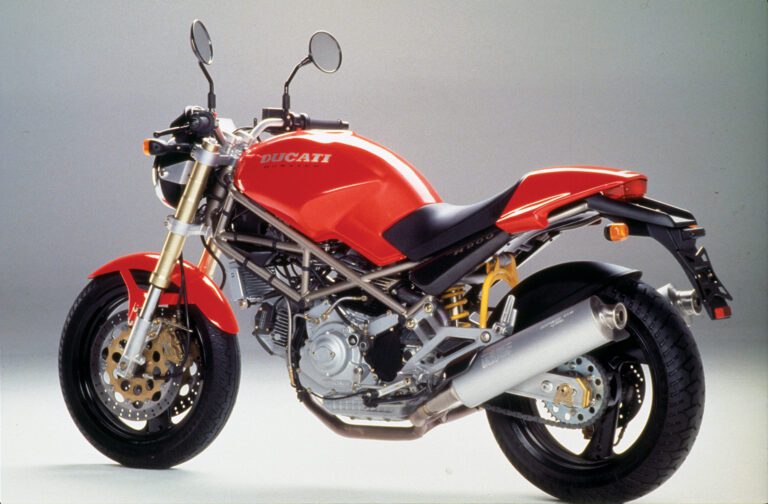
Ducati M900 Monster
- Years produced: 1993-1999 (904cc carburetor engine)
- Power: 73hp (claimed) @ 7,000rpm
- Top speed: 118mph
- Engine: 904cc air/oil-cooled SOHC desmodromic 90-degree V-twin
- Transmission: 6-speed, chain final drive
- Weight/MPG: 441lb (wet)/40mpg
- Price then/now: $8,950 (1994)/$3,000-$6,000
Until 1993, streetfighters were the province of impoverished riders who had low-sided their sport bikes and couldn’t afford to fix the busted bodywork, so they made a feature of the naked look. Things might have stayed that way without the inspiration of Miguel Angel Galluzzi. The story goes that then Ducati technical director Massimo Bordi challenged Galluzzi to design a new motorcycle that could be extensively customized with factory or aftermarket options. That implied a minimalist machine without bodywork. Bordi also wanted to minimize development costs while avoiding a proliferation of new parts. It’s said that Galluzzi already had the solution in mind.
Galluzzi fitted Fabio Taglioni’s tried-and-true 904cc air/oil-cooled desmodue (desmodromic valve actuation) engine into a steel-tube trellis frame adapted from the 750/900SS and 888 Superbike, and with the bare minimum of ancillaries. The result was effectively the first factory streetfighter, and it defined the features and aesthetics of a generation of naked bikes. It was instantly named Il Mostro (The Monster) by the factory team.
As Ducati’s best-selling model ever, the Monster has been described as “the bike that saved Ducati,” representing more than 50 percent of the output from Borgo Panigale between 1993 and 2014. The instant success of the Monster no doubt helped make Ducati an attractive buy when Cagiva sold the company to Texas Pacific Group in 1996.
The 1993 Monster’s engine came in 900SS tune producing 73 rear wheel horsepower. The single crankpin, V-twin engine used one belt-driven overhead camshaft per cylinder operating two valves via desmodromic followers. Fueling was courtesy of a pair of 38mm Mikuni BDST CV carburetors, and sparks from an electronically triggered Kokusan ignition system. A gear primary transmitted power to Ducati’s familiar dry multiplate clutch and 6-speed gearbox. As an integral part of the triangulated frame, the engine also carried the swingarm pivot in the rear of the transmission case. Said swingarm was fabricated in aluminum, with a rising-rate linkage to a single Sachs-Boge spring/damper unit with preload and rebound adjustment. At the front was the non-adjustable Showa 41mm upside-down fork from the 750SS. The 17-inch Brembo wheels and triple-disc brakes were from the 900SS.
Equipment was intentionally minimalist (the Monster had to wait until 2000 for a tachometer!), with a single circular headlight and bolt-on handlebars. But it did include a removable seat cowl with a vestigial passenger perch underneath.
Alan Cathcart tested one of the first Monsters for Cycle World in 1993 and concluded, “It’s been a long time since I’ve ridden a street bike which so succinctly encapsulated the fun-factor in motorcycling. This is a red-blooded street rod par excellence.” Rider magazine’s tester found little to fault except some stiction in the stiff, under-sprung front fork — though that was mitigated by the ease with which the front wheel could be lofted: “Front tire flat? No problem! Just wheelie home!”
The Monster 900 remained essentially unchanged until a Marzocchi 40mm fork with preload and rebound adjustment arrived for 1996. 1997 saw a handlebar fairing fitted and the engine re-tuned for lower-down torque with smaller valves and reduced compression, giving 67 horsepower. A new model, the 900S with the 73 horsepower engine, arrived in 1998, and the 900, 900S and new “Cromo” were fitted with an adjustable Showa fork. By 1999 these were joined by the Dark, City, and City Dark models with cosmetic variations. By this time, the Monsters were the only Ducatis still using carburetors; a new, Pierre Terblanche-styled M900 with fuel injection arrived for 2000.
According to Motorcycle News, 300,000 Monsters had been built by 2016. It seems like Galluzzi’s big gamble really paid off! MC
Contenders: Naked Alternatives to Ducati’s M900 Monster
1988-1991 Honda Hawk GT NT650

- 1988-1991
- 37.5hp @ 7,500rpm/115mph (period test)
- 647cc liquid-cooled SOHC V-twin
- 5-speed, chain final drive
- 412lb (wet)/41mpg (avg./period test)
- Price then/now: $3,995 (1988)/$1,200-$2,700
“The Hawk is the most creative reinterpretation of the standard motorcycle anyone has dared to try, ever,” wrote Cycle magazine in its review of the Hawk GT. But was it worthy of sharing the name of Honda’s groundbreaking early twins?
The GT combined a stretched version of the Shadow 500/VT500 Ascot engine with a brand-new alloy perimeter beam chassis and “Pro Arm” RC30-derived single-sided swingarm with chain drive. The liquid-cooled, dual-crankpin 52-degree V-twin used three valves per cylinder feeding a 5-speed transmission by gears.
Like the Monster, bodywork was minimal. But that’s where similarities end. While the Monster was flashy and raucous, the Hawk was refined and “polished,” Cycle said. It delivered modest power but across a broad torque range, and handled with “impressive agility” and “outstanding cornering clearance.” Plus points: A centerstand was stock and the Pro Arm gave easy rear wheel access. Minus points: limited fuel range (130 miles including reserve), thin seat padding and minimal suspension adjustment.
1992-1995 BMW R100R

- 1992-1995
- 60hp @ 6,500rpm (claimed)/112mph (period test)
- 980cc air-cooled OHV flat twin
- 5-speed, shaft final drive
- 478lb (wet)/48mpg
- Price then/now: $7,990 (1992)/$2,500-$5,500
The Beemer is the granddaddy in this class, little changed from Hans-Guenther von der Marwitz’s R50/5 of 1970.
Adapted from the R100GS, the R100R used the same frame and 60 horsepower air-cooled flat twin, but with a shorter (Showa) fork, 18-inch front wheel, low-level exhaust, and “classic” round rocker covers.
Final drive was by shaft using BMW’s Paralever single-sided swingarm, with a single rear Showa shock adjustable for preload and rebound. Seat height was down 2 inches from the GS at 31.5 inches. A four-pot Brembo disc stopped the front wheel, with BMW’s traditional SLS drum at the rear.
Cycle World tested the R100R in 1992 and liked the relatively light weight, low center of gravity and wide handlebar giving “a surprisingly light-steering package,” concluding, “It’s hard to imagine a more likeable, more capable all-round street bike.”
The R100R’s swan song was the 1993-95 Mystic with revised tail section and finished in Mystic Red. The last of the Airheads was the 1996 R100GS.