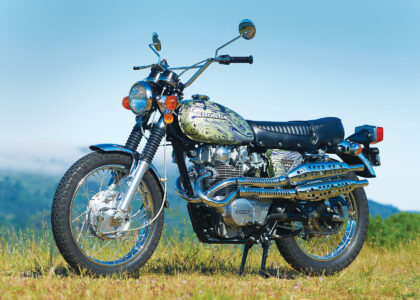
Some of the most dramatic, innovative motorcycles ever conceived never made the transition from prototype to production. Such is the case for the BSA Fury/Triumph Bandit DOHC 350, Yamaha GL750 four-cylinder two-stroke street bike, and the Harley-Davidson Project Nova 400/500 V-twin, 800/1000 V4 and 1200/1500 V6.
In some cases, those “never-were” models may have been breakthrough designs that could have rescued the manufacturer from financial calamity. The Triumph Bandit/BSA Fury 350cc twin potentially could have allowed BSA/Triumph to capture a big slice of the market then owned by the popular Honda CB/CL350. The Honda had its well-proven single overhead cam engine, but the BSA/Triumph 350 planned to come on strong with the performance of a double overhead cam engine — an industry first with the exception of some Italian exotica.
In the case of the series of motorcycles developed under the Project Nova code name by AMF/Harley-Davidson, there could have been significant long-term effects. The line included a small V-twin (400 or 500cc), a middleweight V4, and a top-line industry-first V6. All engines were to be double-overhead cam, liquid-cooled, and counterbalanced. These high-revving, high-tech engines could have expanded Harley’s market reach and appealed to buyers seeking alternatives to its classic torquey V-twins.
The Yamaha GL750, first shown around 1971, would have been the company’s first big 750cc street bike. Financially, Yamaha likely could have produced it for North America, but likely anticipated regulatory headwinds suggest its four-cylinder, two-stroke engine was always meant for the track, not the street.
There are many reasons why promising designs never reach the street: financial, technical, regulatory, or a mix of all three. Whatever the cause, each of these remarkable bikes is a case of a would-be classic that, sadly, never was.
BSA Fury/Triumph Bandit double-overhead cam 350cc twin (Project P30) 1966-1971
The BSA Fury/Triumph Bandit 350cc parallel twin, code-named P30, was Edward Turner’s final design for the financially troubled BSA/Triumph. Turner, a respected figure in British motorcycling, had earlier designed the innovative 500cc SOHC Ariel Square Four soon after joining Ariel in 1928 under chief engineer Val Page. In 1966 or early 1967, Turner began designing a new middleweight motorcycle to challenge Honda’s DOHC 450 twin (launched in 1965) and outperform the popular 305cc twins sold since 1959. Capturing that market could help rescue the company financially and preempt the SOHC CB/CL350 Honda due in 1968. The British bike would feature a first-in-class DOHC engine.
Initially intended as the BSA Apollo, then the Fury, the new twin was also planned as the Triumph Tiger 350, later renamed the Bandit. Both were slated for the 1971 model year, but timing is everything, and design and engineering delays doomed the project. Though the idea of a high-performance lightweight machine made sense, Turner’s design faced internal resistance, including company politics. Bert Hopwood, general manager of Triumph Engineering, was unhappy that some of his staff were assigned to work with Turner, an outside consultant not accountable to him. He also questioned the design’s reliability. As a result, Hopwood and design engineer Doug Hele undertook a complete re-engineering of the bike.
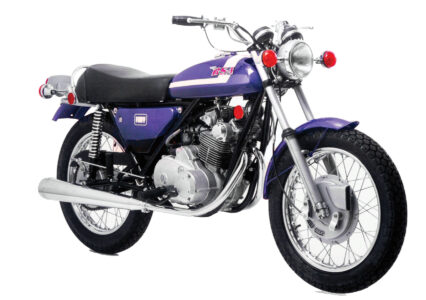
The engine was converted from a 360- to a 180-degree crankshaft, but the crankshaft had to be redesigned completely due to balance problems and poor engineering that resulted in the crankshaft on both initial prototype engines failing during testing. Wrist-pin and valve spring materials were also revised, along with redesigned connecting rods and pistons.
The valve train underwent complete renovation. In Turner’s original design, the cam chain was in the middle of the cylinder bank; Hele and Hopwood moved it to the left side of the engine, making service work on cams and chain easier and simplifying the valve train.
Engine noise problems required the addition of cast-in ribs and insertion of nitrile rubber inserts between the cylinder cooling fins to deaden vibration. Oil leak and head gasket problems were also addressed. The contact breaker box had to be relocated from the left to the right side of the engine, and an improved oil pump was added. The transmission was upgraded to a five-speed with left-side shifter, and there was accommodation for an optional electric starter.
Despite this, the engine still needed work. Liaison engineer Tom Gunn found the head and valve design poor and recommended changes to improve intake and exhaust flow, boost horsepower, and increase fuel economy. Due to retooling costs, none of Gunn’s changes were implemented, causing further delays. However, efforts were made to adapt the head for a four-valve-per-cylinder setup.
After all this rework, the essentially all-new engine delivered 34 crankshaft horsepower at 9,000rpm equipped with standard type exhaust, air filter, and carburetors. Perhaps even more important, it could spin up to 10,000rpm repeatedly without converting itself to bits for recycling.
Turner’s original frame lasted through early development but needed strengthening. By the time the engine was a working prototype, the chassis couldn’t fit it as designed, so adjustments were needed. In a departure from BSA standard practice, the swingarm was fabricated as a pressed steel assembly, but later returned to standard tubular steel construction.
Early prototype styling models kept the radical external coil spring forks, but replaced Turner’s unusual non-hydraulic, cable-operated disc brake with a conical hub style twin leading shoe brake. A single leading shoe conical unit was used on the rear wheel. By that time, the cocktail shaker-style mufflers and angular fuel tank envisioned in Turner’s design had given way to a more conventional style. Soon, the forks were replaced by more conventional internal spring aluminum slider forks.
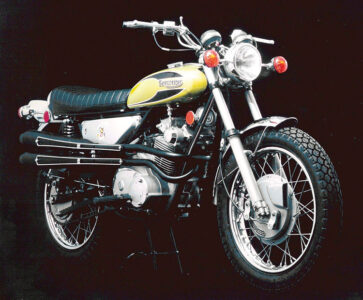
With the production start target date having been moved forward from November 1971 to March 1971, approximately 12 running prototypes were built at Meriden. From those, final refinement work would continue, and several would be made available for magazine road tests.
A detailed review was done by Bob Braverman of Cycle Guide magazine in March 1971. Braverman had the opportunity to go to England and ride both the BSA Fury and Triumph Bandit SS (the high-pipe scrambler version) at the Silverstone Grand Prix racing circuit.
The air-cooled alloy engine was scrutinized in depth, and the use of an old-fashioned vertically-split crankcase instead of a horizontally split crankcase was questioned, since it is more prone to oil leaks and prevents the use of a crankshaft center main bearing. During the road testing, no engine oil leaks occurred, except from the tachometer connection at the top of the engine when the overly short tach drive cable pulled out of the engine when the bars were turned hard right.
The bike’s overall fit, finish, and sound level earned high praise from Braverman: “One interesting thing about the new Triumph 350 is the low noise level. Most overhead cam engines are fairly noisy, not so with the Triumph. It’s surprisingly quiet.”
While the bike’s conical twin-leading shoe front brake drew praise, the conical unit on the rear was noted as “useless.” Brakes aside, the bike’s handling was praised as “surefooted on wet or dry pavement.”
Braverman was impressed by the bike’s performance and fresh design, saying it was, “So good, in fact, that our guess would be Triumph and BSA are going to be able to sell all they can crank out in the next 12 months.”
Sadly, the BSA Fury/Triumph Bandit DOHC 350 never had the chance to prove Braverman’s prediction right. In November 1971, the company announced that the start of production was being suspended and that it was not anticipated as a model for 1972. BSA folded in 1972, but Triumph continued until 1973, when the Norton Villiers Triumph conglomerate was formed, but that only bought time until early 1976.
Yamaha 1971 GL750 four-cylinder two-stroke
The liquid-cooled, fuel-injected, four-cylinder, two-stroke Yamaha GL750 street machine may well have been the homologation platform for the race-ready TZ750 that carried Giacomo Agostini to victory at Daytona in 1974. Finnish 1972 world champion in the 250cc GP class, Jarno Saarinen, won the Daytona 200 in 1973 on a liquid-cooled twin-cylinder Yamaha, and Don Emde had set the two-stroke take-over of the Daytona 200 in motion with his stunning victory aboard a 350cc Yamaha TR3 twin in 1972.
Emde’s victory was history-making because it marked the first time the Daytona 200 was won by a two-stroke powered machine, it was the first time it was won by a bike with an engine displacing only 350cc, and it was the first time, and remains the only time, a father and son duo were Daytona 200 champions — Emde’s father, Floyd Emde won the event in 1948 aboard an Indian.
It may also have been the case that the four-cylinder road-burner never saw production because of more stringent tailpipe emissions standards that would be applicable by 1973 in the U.S. and a number of other nations. These were standards a high-performance two-stroke engine of that era may not have met, though the Suzuki GT750 triple was produced through the 1977 model year, and the Kawasaki H2 through 1975.
The Nippon Nightmare, as it may have come to be known, broke cover at the 1971 Tokyo Motor Show, and Dave Holeman was there to cover it for the January 1972 issue of Cycle Guide.
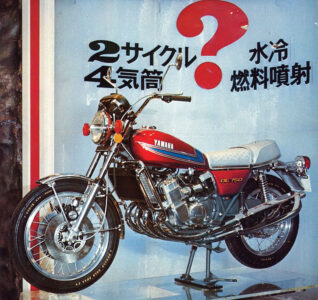
That Yamaha came out with a new entry for the 750cc class really wasn’t much of a surprise; as of the 1971 model year, the top of Yamaha’s line was the 650cc XS1B twin, while Honda and the remaining British brands all had 750cc multi-cylinder bikes on offer. What was a surprise was the form its entry into the 750cc class appeared to have taken.
The bike included a range of advanced features, starting with four gleaming, polished water-jacketed cylinders. If that wasn’t unique enough, those pots were fed by four fuel injectors, which would have positioned the bike as the first fuel-injected street bike in the world. Induction control by seven piston ports, or future reed valves, was described.
Sources indicated that the fuel injection system on display was a prototype under consideration for the Yamaha snowmobile line. The system reportedly used a diaphragm pump that operated on engine vacuum.
Stopping power to slow the (claimed) 451lb machine was provided by dual hydraulic disc brakes up front using the same components as those used on the XS650. Following standard practice of the day, the rear brake was a rod-activated mechanical drum unit.
Though nobody had the opportunity to plumb the depths of the bike’s internals — if indeed it even had any — more than likely, it would have been what later showed up on the TZ750 (OW19) racing machines in time for the 1974 Daytona 200. That being essentially two TZ350 liquid-cooled twins siamesed together with two center-coupled 180° crankshafts that brought their power together in the middle of the engine via a thin gear on the inboard end of each crankshaft. These gears drove a double-width gear on a jackshaft that fed power to the dry clutch on the right side and on to the six-speed transmission. The race bike utilized reed valves. Period dynamometer tests of the TZ750 race version showed corrected rear-wheel horsepower of 97 @ 10,400rpm.
In a sense, though the Yamaha GL750 prototype street bike was never manufactured, its radically different production racer versions — the TZ700 and TZ750 — were.
Harley-Davidson Project Nova 400/500 V2, 800/1000 V4, & 1200/1500 V6 1976-1982
In 1976, at meetings in Pinehurst, North Carolina, AMF/Harley-Davidson executives recognized the need for a long-term strategic plan. The success of the Honda CB750, Kawasaki Z1, and Yamaha XS750C showed U.S. riders wanted high-revving, technically advanced bikes that their long-stroke V-twins couldn’t deliver. They also acknowledged the popularity of their air-cooled V-twins but agreed an update was needed. The plan had two parts: revamp the air-cooled V-twin into the Evolution (“Evo”) engine, and develop a new product line, code-named “Project Nova.”
Project Nova led to the development of advanced 60° liquid-cooled, counterbalanced DOHC V-twin in V4 and V6 models. All shared the same bore and stroke for modular use of pistons, rings, rods, and cylinder head parts. Displacements would either be in 200cc or 250cc per cylinder increments, resulting in a V-twin of either 400cc or 500cc, V4 of 800cc or 1000cc, and V6 of 1200cc or 1500cc.
Running the Evo and Nova projects simultaneously required outsourcing some work to have enough engineering manpower. The Evo project was entirely done in-house, but the Nova Project split the workload with Porsche being tapped to develop the engine and transmission packages, with chassis and styling work done in-house.
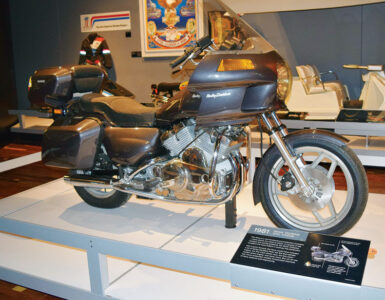
Initial designs included major departures from tradition beyond the engines. The original concept had shaft final drive, but belt drive was ultimately chosen. New bodywork featured a ducted fairing on touring models to direct air to a horizontally mounted radiator under the seat. The fuel tank was also placed under the seat, with the filler neck on the rear fender. The engine would be a stressed member of the chassis. Carburetors and two-valve heads would be specified initially, but plans included eventual use of four-valve heads and fuel injection.
With work starting in 1977, how far ahead of the curve were the Nova bikes? It would be 2016 before H-D would have liquid-cooled heads, fuel-injected, counterbalanced, four-valve-per-cylinder engines in their road bikes in the 107 cubic inch and 114 cubic inch Milwaukee Eight engines.
Power delivery was projected to be approximately 100bhp per liter of displacement, pegging the 1000cc V4 in the 100bhp area; the 1500cc V6 at about 150bhp, for example.
While no motorcycle media road tests of any of the more than two dozen running, rideable prototypes took place, Vaughn Beals, the CEO and chairman under AMF and after the June 1981 buy-back, did ride one of the V4 prototypes. He praised the bike’s power and handling, but also had to preside over a tough choice: after the buy-back, which removed the development capital AMF had provided, there were only enough financial resources for completion of development of the Evolution engine or the Nova bikes — but not both.
Times being what they were, the company struggling with substantial debt and the development of the Evo engine nearing completion, and efforts to arrange funding to continue Project Nova having failed, in 1982, the project was terminated. That said, the connections with Porsche that were established by Project Nova ultimately led to the collaboration on the Revolution engine for the VRSCA V-Rod, and the wind tunnel work resulted in the Nova ducted fairing design and luggage finding a home on the 1983 FXRT Sport Glide.