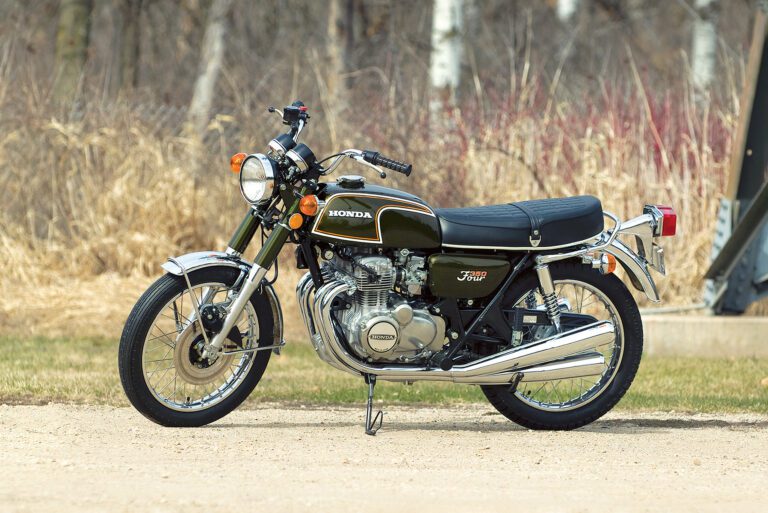
1973 Honda CB350F
- Engine: 347cc SOHC transverse-mounted inline four, 47mm x 50mm bore and stroke, 9.3:1 compression ratio, 34hp @ 10,000rpm (rear wheel, estimated)
- Top Speed: 98mph (period test)
- Carburetion: Four 20mm Keihin
- Transmission: 5-speed, chain final drive
- Electrics: 12v, coil and breaker points ignition
- Frame/wheelbase: Single downtube steel cradle frame, 53.3in (1,354mm)
- Suspension: Telescopic fork front, twin shock absorbers w/adjustable preload rear
- Brakes: Single 10in (254mm) disc brake front, 6in (152mm) SLS drum brake rear
- Tires: 3 x 18in front, 3.5 x 18in rear
- Weight (dry): 373lb (169.2kg)
- Seat height: 31in (787mm)
- Fuel capacity/MPG: 12.1-liters (3.2 gal.)/40-60mpg
- Price then/now: $1,100/$800-$3,000
Magicians like David Copperfield and Criss Angel stun and amaze audiences with their mind-bending stunts and tricks. While Honda isn’t generally recognized as a magic act, the company did stun and amaze the motorcycle community in 1969 when they introduced the CB750 Four — the first in a new generation of quality, oil-tight, large displacement multi-cylinder machines. And while they started big, Honda still had a couple of other tricks up its corporate sleeve.

Two years later, in 1971, Honda introduced the smaller CB500 Four. Cycle Guide magazine thought the CB500 was quite the package, as its August 1971 issue headline blared: “They’ve Done It Again: Honda has unleashed another new standard for the motorcycle industry to follow.”
If that wasn’t amazing enough, Honda’s next magic act was to decrease the size of its four-cylinder engine package even farther. In the spring of 1972, Honda introduced the CB350F. “Honda had blown everyone away with the 1969 introduction of the CB750 Four,” says Honda enthusiast and collector Doug Sheldon. “In 1971, the CB500 Four was released, again ‘one-upping’ all the competition. So the 1972 release of the 350 Four was almost a natural progression — a statement as to what Honda engineers could do.” The world’s first mini-multi, it was the smallest capacity multi-cylinder motorcycle to ever enter into full-scale production.
Through the years
Honda had, of course, been developing the multi-cylinder power plant over many years, with experience gained in both their motorcycle racing exploits and their efforts with V-12 Grand Prix formula racing cars. By the time they introduced the 350 Four in 1972, the design and layout of the Honda SOHC four-cylinder engine was well established, helping coin the term “Universal Japanese Motorcycle,” or simply UJM as the basic layout was called.

In the Honda CB350 Four, this meant a transversely mounted four-cylinder engine featuring a chain-driven single overhead camshaft. Crankcases were of the clamshell type, split horizontally to allow easy assembly of the unit-construction gearbox and the five-plain bearing crankshaft. Primary drive was by chain, taken from the center of the crank to an inboard-mounted clutch. The 350 Four engine is undersquare, meaning the 50mm stroke is longer than the 47mm diameter of the bore. And at 47mm, each of the four pistons is not much larger than a medium-sized plastic pill canister you get from the pharmacy.
The multi-cylinder power plant resides inside a single-downtube steel cradle frame featuring dual shocks acting on a traditional swingarm at the rear. Hydraulically dampened telescopic forks hold an 18-inch wheel and a single 10-inch (254mm) disc between the legs. Rear wheel diameter is the same as the front, and the rim is laced to a hub with a 6-inch (152mm) drum brake.
Sheet metal — including the fuel tank — is unique to the Honda CB350F, and it’s a bit more angular in appearance than the tanks found on the large capacity machines. All bodywork including the tank, side covers and fork covers is painted, while front and rear fenders are chrome plated.

One of the most distinctive features of the early Honda four-cylinder motorcycles was the four-into-four exhaust system. With its four header pipes dumping into four pleasingly- shaped conical mufflers, the bike looks stunning from both profile and rear views. But that exhaust system, and specifically the mufflers, was quick to rot away.
“Overall weight had to be a constant focus in the designing stage of the 350F. For the final design, all four original exhaust pipes and mufflers weighed less than 25 pounds,” Doug says, explaining the issue. “Honda used very thin metal on the muffler part of each pipe to cut down on weight. Consequently, they didn’t last very long.”
A passion for Hondas
Doug has been interested in Hondas since his university days when he rode a 90cc CA200 around the Penn State campus. After he sold that bike, he rode a Honda XL250 for about 10 years. Doug then took a step back from motorcycling until 1999, when he decided he’d put his boot leather back under a shifter. Flipping through Walneck’s magazine, he found a 1976 CB550 with 416 original miles. The bike came home with him because it was the exact year and Candy Garnet Brown color he wished he’d purchased back then. And because it was in such superb condition, Doug decided to detail it and kept the Honda as a showpiece.
Over the years, Doug’s always been collecting “something,” whether antiques or coins. Now, he’s collecting original, low-mileage Honda motorcycles.
“I’m a small, single-digit percentage of people who believe in originality rather than restoration,” Doug says. “They’re only original once, and when applied to motorcycles that means they all have some nicks and scratches, but I love that patina.”

While he has bikes he doesn’t ride — such as the 1973 Honda CB350F featured here — he does have other machines that see regular use. But those are motorcycles that don’t have the extremely rare original four-into-four exhaust pipes, or else they have a lot more miles on the odometer.
“Surviving examples of the 350F are almost always found with rotted out original pipes,” Doug says, “or an aftermarket set of four-into-two pipes. In 1974, Honda’s list price on a set of four new original pipes was $126. Period after market slip-on mufflers converting the exhaust into a four-into-two system could be had for far less than that.”
According to Doug, 2003-2004 was the last time Honda listed original pipes as available, and by then a set of four cost more than $1,000. A set of original pipes is now a coveted prize for the enthusiast-collector who wants the original bike look — meaning even if a set could be found they’d likely be mounted on a display-only machine. We’ve heard of owners paying as much — or more — for a set of perfect pipes as for an entire CB350 Four.

The 1973 CB350 Four featured here was discovered in the Milwaukee area. The bike was for sale on eBay, and Doug managed to win the auction at the seller’s reserve. The story is that the eBay seller purchased the Honda from the original owner, with the intention of flipping the bike. While the machine was indeed a low-mileage motorcycle, it unfortunately had the ubiquitous four-into-two exhaust system installed.
But that didn’t bother Doug, as he’d earlier located a set of factory four-into-four pipes and bought them “just in case.” With the CB350F back home, Doug found the original owner had taken very good care of the motorcycle.
“There was zero sun fade on anything, and I’m certain the bike had never been washed and it certainly never saw any rain,” Doug says. “All of the original tools were in the pouch, and they were bright and shiny.”
He got the bike running, dialing in the carbs before riding it around the block several times. After that, Doug removed the gas tank, saddle, side covers and the exhaust system; only as many items as necessary to perform his detail job. Doug’s not a fan of putting wrench marks on fasteners, so using 0000 steel wool, naphtha, toothbrushes, Q-tips, toothpicks and detailing products he spent upwards of 75 hours cleaning the Honda.
“I can detail my own bikes, but you couldn’t pay me enough to do it to someone else’s,” Doug says. “I’m very good at detailing a motorcycle — focusing on preserving its original condition without over restoring it. I’m sure there are people better at it — I would like to cross paths with them to learn about better tricks and techniques.”
With the detailing done, all that was left was installing the factory-fresh four-into-four exhaust system. The machine is now “pickled,” or preserved, and on display in Doug’s personal showroom.
When properly set up, a 350 Four starts easily, especially once it’s warmed up. “With the carbs adjusted and the electrics just right, you should hardly hear the starter engage; it fires up that quickly,” Doug says, adding, “And, it’s a very quiet motorcycle.”

Quiet, yes, but not necessarily powerful, an observation reviewers made when it was new: “The 350F is short on torque, so you need revs,” Doug says. “Nothing really great happens until about 5,000rpm. The bike redlines at 10,000rpm and can be counted on for reliable running all day at high rpms. 60mph is roughly 6,000rpm.
“The 350F is silky smooth,” he adds, “with some vibration showing up at about 5,500 to 6,000rpm but quickly disappearing beyond that. It isn’t that bad, but it stands out because of the overall smoothness of the bike.”
Surprisingly, Honda’s 350 Four was introduced and sold alongside their lighter and even more powerful CB350 twin. “Honda had in some respects created its own competition because of their CB350 two-cylinder,” Doug says. He calls the 350 twin Honda’s “bread and butter” sales winner, one that sold well following its 1968 introduction.
But the similarities ended after their shared engine size designation. The difference in price — in 1972, the twin was about $800 retail, while the 350 Four was about $1,100 — got you a lot of sophistication, refinement and neatness. Both bikes had a completely different feel as to riding experience. The twin was quicker, cheaper and lighter by about 20 pounds, but Honda was targeting those who would read the 350 Four as a neat piece of engineering.
Short-lived design
Neat piece of engineering or not, the 350 Four didn’t last very long. Honda’s CB350F had a three-year production run, from 1972 to 1974. There were no changes to the 1973 model, and Honda offered the machine in two colors for the first two years — Flake Matador Red and Candy Bacchus Olive. Honda referred to the 1972-1973 models as the CB350F, while the 1974 production was the CB350F1. And for 1974 only one color was available, and that was Glory Blue Black Metallic.
Although Honda did not continue the CB350F into 1975, its engineering did not go to waste. The CB400F, based on the CB350F, was introduced in 1975. The CB400F is something of a cult-classic machine itself, featuring the 350cc engine punched out to 408cc and a distinctive café racer look.

Other distinguishing 400F features include the snaky four-into-one exhaust pipes and another gear in the box, bringing the total to six speeds. In production from 1975 to 1977 the CB400F was another three-year production machine.
To learn more about the Honda CB350F, Doug’s done a bit of his own research recording VIN numbers. From what he’s been able to document, he believes some 70,000 CB350Fs were built between 1972 and 1973. Of the 1974 machines, he estimates less than 10,000 were produced. The CB350 Four was sold worldwide. “The easily recognizable 1974 models, because of the color, are not often encountered because I believe sales dramatically slowed down for the last year of production,” Doug says. “The magic of the bike, as such, had worn off.”
Maybe so, but these days, a new audience is rediscovering the magic of Honda’s littlest four, and values are on their way up. MC
Press Reports
“We are again reminded that some motorcycles have an appeal transcending mere numbers. Honda’s new 350cc Four is easily the heaviest, most expensive thing in its displacement class … But there is some indefinable something about this newest Honda that gets people turned-on and lusting after its shiny little carcass.”
– Cycle, August 1972
“This bike will probably not appeal to everybody wanting a 350 roadster. Our guess is that it is slanted toward those riders who want something a bit better than their neighbor’s 350 twin.”
– Cycle Guide, August 1972
“The 350 Four, least expensive of Honda’s multi-cylindered line, is going to create a new clique of super fans.”
– Cycle World, April 1973
“The CB350F is for small to medium-size riders who want a four-cylinder touring machine for medium-range trips.”
– Cycle Guide, December 1973