1959 Triumph Speed Twin

- Years produced: 1959-1966
- Claimed power: 27hp @ 6,500rpm
- Top speed: 90mph (est.)
- Engine type: 490cc OHV parallel twin
- Weight: (dry) 155kg (341lb)
- Price then: $710 (approx.)
- Price now: $6,000-$15,000
- MPG: 50-60mph
If a bike’s impact on the industry and longevity in production are any measure of success, there are few designs that come close to the 500cc Triumph Speed Twin, the first commercially successful parallel-twin cylinder motorcycle. Almost every major motorcycle manufacturer of its time copied or emulated it, and it remained in production for 28 years.

It’s often said that there’s really nothing new in motorcycling. Most of the “new” ideas that found widespread favor starting in the 1960s — overhead camshafts, multiple valves, electric start — had all been tried before 1920, and usually abandoned because of high cost, poor fuel and underdeveloped metallurgy. The fledgling Triumph Co. actually experimented with parallel twins in the years before World War I, before abandoning its efforts in order to produce the more mundane Model H “Trusty” — the 550cc belt drive, side-valve single that served so well on the battlefield.
Edward Turner, Jack Sangster and Valentine Page
Although the Triumph Speed Twin designer, Edward Turner, started his career as a motorcycle dealer, he had a great interest in designing motorcycles. In the late 1920s, he submitted his plans for a 4-cylinder engine to Jack Sangster, owner of Ariel. Impressed, Sangster hired Turner to complete the design and put the machine into production. The result was the 500cc overhead cam 1930 Ariel Square Four. Turner became Ariel’s rising design star — a situation that did not sit well with chief designer Valentine Page.
Page left Ariel in 1932 to join Triumph, where he continued development of an idea he had hatched at Ariel: Page assembled a promising 250cc parallel twin using one of the two crankshafts from Turner’s Ariel Square Four, then took the idea one stage further, designing a 646cc OHV parallel twin. The design, known as the 6/1, incorporated many significant innovations that would find their way into later designs by other manufacturers, such as gear primary drive, a single camshaft, semi-unit construction, oil tank cast in the crankcase and more. Page’s twin proved powerful and reliable, if overbuilt and expensive to make. A limited number of machines were produced, mostly sold for sidecar duty.

In the meantime, Triumph had foundered. In 1936, arch entrepreneur Sangster snapped up the bankrupt motorcycle business, installing Turner as its chief designer and senior manager, so that he now became Page’s boss. Turner used his design flair to revamp the Triumph range of 250cc, 350cc and 500cc singles (all Val Page designs), giving them smart, colorful finishes and evocative names: Triumph Tiger 70, 80 and 90, the numbers intending to indicate their top speed in miles per hour. (This somewhat fanciful nomenclature later became ever more divorced from reality, ultimately with the T140 Bonneville and T150 Trident.)
After the singles, Turner’s next design was his masterstroke: the 1938 Triumph Speed Twin. Though many have accused Turner of stealing Page’s parallel twin concept, Turner acolytes are quick to point out that Page also borrowed from Turner’s Ariel Square Four. Either way, it was Turner’s genius for what we now call consumer product design that secured the Speed Twin’s success.

To his advantage, Turner was endowed with a number of important abilities: He understood the conservative British motorcyclist, so he designed the Twin to resemble the familiar twin-port single; he had an intuitive flair for what later became finite element analysis, designing parts that were “just” sufficiently strong and durable without being over-engineered; and he was a master stylist. Faster or not, the Triumph Speed Twin looked sleeker, speedier and svelter than its contemporaries. In fact, almost all of the subsequent British parallel twins borrowed at least some of its design themes and motifs.
Before the “bathtub”
The Triumph Speed Twin would have stayed in continuous production but for World War II and the destruction of Triumph’s Coventry, England, factory in a Nov. 14, 1940, air raid. Production resumed in 1946, the Speed Twin sporting a new telescopic fork but otherwise largely unchanged. In 1947, a sprung rear hub was offered as an option. Instead of being solidly mounted to the frame, the rear wheel spindle was supported on coil springs set inside the large diameter hub, giving a travel of around 2 inches. There was no damping. The system worked OK when new, but any wear in the hub allowed the spindle to tilt, upsetting the bike’s handling.

In 1950, the Triumph Speed Twin received a cosmetic makeover with a headlight nacelle incorporating the instruments, and a new fuel tank design featuring four horizontal bars — a “streamline” motif now found on the Yamaha Star Roadliner and Stratoliner.
Then in 1952, the Speed Twin’s generator and magneto were replaced by a Lucas alternator and battery/coil ignition system. Though principally a cost-saving measure, this represented a significant technological breakthrough — something akin to switching from carburetors to fuel injection — and Triumph pioneered this move amid much suspicion from notoriously conservative British bikers. (As late as the end of the 1960s, the magneto vs. alternator argument was still contentious. In 1952, it was considered close to treason!)
Next came a new frame for the Speed Twin. First used on the flagship 650cc Tiger 110 in 1954, the swingarm rear end arrived for the Speed Twin in 1955. Full width aluminum brake hubs arrived in 1957 — but a major development was in the wings.
Unit construction and “bathtub” styling
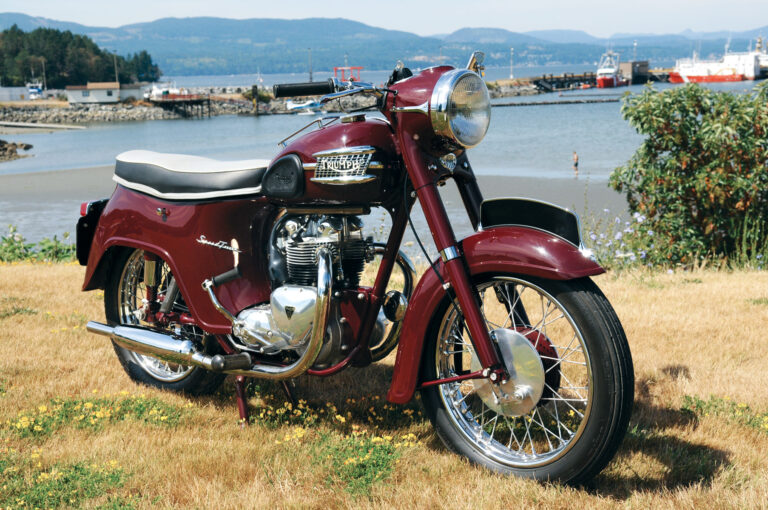
The first Triumph twin with the transmission in unit with the engine was the 3TA (A for unit construction) “Twenty-One” of 1957 — the name celebrating 21 years of the new Triumph company, and the swept volume of the 350cc engine in cubic inches. With the Triumph Twenty-One came revolutionary styling — the “bathtub” rear enclosure with a deeply valanced front fender, a styling statement adopted next by the Triumph Speed Twin and then the Thunderbird. Love it or hate it (U.S. buyers mostly hated it), the bathtub — inspired by the scooter craze then sweeping Europe — was meant to represent the newest in sleek lines and cleanliness.

Unfortunately, the riders attracted to scooters weren’t the same people buying large motorcycles, and the fate of the majority of bathtub Triumphs was to be stripped of the bodywork and fitted with aftermarket fenders. The removed bodywork often went for scrap or rusted away in back yards. This was particularly true in the U.S., where Triumph was marketed as a performance brand; auntie’s voluminous skirts just didn’t look right on a sport bike.
By now, the 500cc Speed Twin, which got unit construction beginning in 1959, was just another model in the Triumph twin range, which included the 350cc 3TA Twenty-One, 500cc Tiger 100 sport, 650cc 6T Thunderbird, TR6A and TR6B “Trophybirds” in street and offroad versions, and — new for 1959 — the T120 Bonneville with twin carburetors.

Triumph was becoming more attuned to its biggest market — the U.S. — and its focus moved to the sporting 650cc bikes, especially the Bonneville. In 1963, the Speed Twin lost its bathtub, getting a smaller “bikini” enclosure before reverting to conventional fenders the following year. But when Triumph’s 1967 range was announced in July 1966, the Speed Twin was missing completely, as was the 650 Thunderbird and 350 Twenty-One models. With their demise went the famous headlight nacelle, a Triumph feature since 1948. Instead, a new 500, the Tiger 100, replaced the Speed Twin — though mechanically it was almost identical to its predecessor.
Kevin Dunn’s Triumph Speed Twin
Our feature Speed Twin’s current owner, Kevin Dunn, is a huge fan of Triumph’s bathtub bikes; as well as the 500, he also owns a very early 1957 350cc Twenty-One. Britain’s Triumph Owners’ Motor Cycle Club has authenticated the 350’s serial number as one of the earliest still in existence. Kevin is also a “third wheel” enthusiast: Not only does he ride a number of sidecar rigs, but he’s also the sole importer of Indian-made Cozy sidecars for North America, and he’s the former owner of Victoria’s Sidecar Café, a motorcycle-themed restaurant on Vancouver Island.

Kevin’s bathtub Speed Twin left the Meriden factory in 1959 and was sold through a dealer in Canterbury, England. The new owner immigrated to Canada, taking the bike with him. About five years ago, a fastidious transmission rebuild specialist by the name of Ken Rotz acquired the Speed Twin in Victoria, British Columbia, and set about renewing it. “Nothing that guy touches is anything less than perfect,” Kevin says.
Rotz’s meticulous attention to detail and his refusal to accept any substandard parts produced an outstanding restoration — and drove local parts suppliers to distraction. Every component was examined by Rotz’s micrometer, and unless the part was within the original manufacturer’s tolerance, it was returned. This did nothing for Rotz’s popularity — to the point where one local dealer in Victoria refused to supply him with any more parts.
Rotz was similarly particular about the bodywork, returning parts to the award-winning painter who had refinished them: They didn’t meet Rotz’s standard, in spite of looking perfect to everyone else. Needless to say, the painter was less than pleased, but the result has to be seen to be believed. The finished paint is so smooth that reflections in it are almost distortion-free.

Kevin’s first meeting with the master restorer and his re-creation was less than auspicious. He and a friend spotted the Speed Twin in a parking lot and were poring over it, discussing the operation of its unusual lever-arm rear brake light switch. Seeing them, and perhaps thinking they were felons, Rotz fired a barrage of less than polite entreaties to move away from the bike. Kevin admits, “If I was going to steal anything, that would be it.”
Any misunderstanding quickly resolved, it turned out Rotz needed to sell the bike to finance another project, and a three-way deal involving a Sunbeam S7 ensued. For a net investment of $1,000, Kevin became the Speed Twin’s new owner. Sitting in his garage with his acquisition, Kevin says, “I thought, ‘Any minute now he’ll come back. I must have stolen it!'”
As good as it looks
A gentle swing on the kickstarter brings the 500 instantly to life, and I quickly discover Rotz’s passion for perfection extends to every aspect of the Speed Twin’s operation as well as appearance. All the controls work smoothly, and the gears shift with a precise click. The engine is unusually quiet for a Triumph twin; there are no oil leaks and no exposed wiring. The suspension is taut, steering precise and brakes effective. Progress is reasonably brisk, the Speed Twin’s 27hp propelling a mere 341 pounds. Kevin says he thinks of the Triumph Speed Twin as a “gentleman’s motorcycle,” and I’d have to agree. With a cruising speed of 50-60mph, the Speed Twin is less comfortable on the freeway; but for a sunny afternoon cruise around the quiet, winding back roads of Vancouver Island, it’s close to perfect! MC