It’s the mid-1960s, and you’re on the hunt for a British Big Twin. Looking at the usual suspects, you click them off in your mind as you ponder your options. Triumph Bonneville? Check. BSA Lightning? Check. Norton Atlas? Check. Enfield Interceptor? Enfield? Yes, Enfield.
Jim Stothard wasn’t looking for a Royal Enfield when he discovered his boss had one. “I was really looking for a Bonneville,” he says. In fact, he wasn’t even sure what an Enfield was. But for some reason, the idea of buying it wouldn’t go away.
The Interceptor had sat in a garage for years, after some ham-fisted wrenching had cross-threaded a spark plug. “I kept joking with my boss, asking when he was going to sell me the Interceptor. One day he said ‘right now,'” Jim recalls.
A deal was done. Jim borrowed the company truck, gathered a few buddies, bought a couple of cases of beer, and the Interceptor was shoehorned up a flight of stairs and into Jim’s third floor apartment.
When Jim got the Enfield 20-odd years ago, British bikes weren’t exactly in favor, with parts scarce and advice even scarcer. One local motorcycle dealer even warned Jim not to bring the bike anywhere near his shop!
Fortunately, he stumbled across Vancouver’s British Motorcycle Owners’ Club, and he was able to enlist a number of members to help out with parts and wrenching advice. Jim duly set to reverse the decay that the passing of time had wreaked, rebuilding much of the bike in his living room. Before he knew it, it was time to see if the Interceptor would start.
Some more buddies, a few more six-packs, and the Interceptor was out of the apartment and back on pavement. With fresh oil in the engine, fresh gas in the tank and a new battery, the bike coughed after a few kicks and was soon running. But blistering chrome on the exhaust headers signaled something wasn’t quite right. Jim handed the bike to another BMOC member, who rebuilt the carbs and re-set the timing, and soon the Interceptor was running like a top. “It’s been flawless ever since,” says Jim. “Apart from a couple of coil wires breaking, I’ve never had a breakdown.”
The engine has 44,000 miles on the original bores, but Jim suspects the pistons may have been replaced early in the bike’s life. He replaced the exhaust valves a few years back, but the rest of the engine has never been apart, and in spite of some mechanical rattles, it runs reliably and cleanly. And the bellow that pours out from the scantily-lined Campbell silencers when Jim winds it up can curdle milk and stampede cattle.
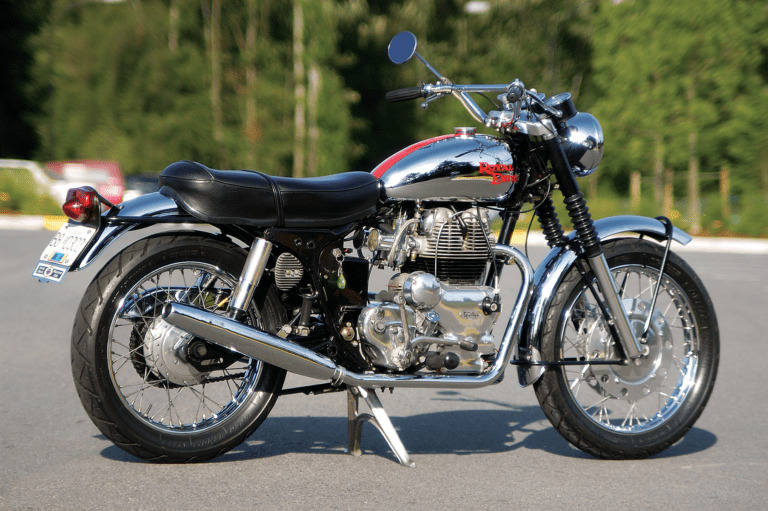
It’s a tribute to Jim’s spit ‘n’ polish that the bike looks as beautiful as it does: You can see your face in the carbs, a real achievement given Mr. Amal’s rough, die-cast zinc alloy. The Mk1A “TT” model that Jim owns left the factory with plenty of chrome to begin with — fork ears, headlight, gas tank — and Jim’s polishing efforts have created a real eye-popper.
Jim’s Interceptor is a 1968 Mk1A, built close to the end of a development line that started long before, in 1949.
Twins it is
It’s a common misconception that Royal Enfield made guns as well as motorcycles, including the Lee-Enfield rifle. It’s a reasonable assumption, given the company’s “made like a gun” slogan.
Many also suppose the company earned its regal prefix by supplying cycles to sovereigns. Neither is correct — though they make for a good story. Royal Enfield got its trademark through good old-fashioned snake-oil salesmanship, and the salesman in question was one Albert Eadie. In 1890, he purchased George Townsend and Co., near Redditch, Worcestershire, in England’s “Black Country.”
Originally a manufacturer of sewing needles, Townsend had turned to making bicycle parts and supplanted its income with sub-contract work, including making gun parts for the Royal Ordnance Factory in Enfield, Middlesex. Eadie appropriated “Royal” and “Enfield” to create the company’s brand name.
Royal Enfield created its first powered vehicles in 1896, but made its name with innovative motorcycles during the Teens and Twenties. It was among the first to develop a fully-circulating automatic oiling system using a separate tank for engine oil. During the depression, Enfield survived by selling inexpensive commuter machines, including a sturdy 225cc two-stroke, and side-valve V-twins for sidecar use. And through WWII, the company’s model C 350cc side-valve single fought alongside better-known bikes from Norton and BSA.
But perhaps the model most often identified with the company is the Bullet. Introduced in 1948, the Bullet, little changed, is still built today in Chennai, India — a production run of 60 years!
Royal Enfield lagged behind Triumph and BSA in building parallel twins, introducing their first “500 Twin” in 1949, the same year Norton’s 500cc Dominator twin hit the scene. Like the single-cylinder Bullet, the dry-sump twin’s oil supply was held in a “tank” cast into the engine behind the crankcase. Separate iron cylinders were spigoted into the crankcase, while two chain-driven camshafts mounted high in the engine operated overhead valves via short, light, alloy pushrods.

When BSA and Triumph both introduced 650cc twins in 1949, Enfield designer Tony Wilson-Jones saw an opportunity to combine the Bullet’s 70mm x 90mm dimensions with the 500 twin’s crankcase, creating the 36hp, 693cc Meteor of 1953. The Meteor begat the 40hp Super Meteor and eventually the 51hp Constellation of 1958. They were Britain’s biggest parallel twins until the AMC and Norton 750s of 1962.
With parallel twins, more capacity usually means more vibration. Uniquely in the British motorcycle industry, Enfield’s big twin crankshafts were dynamically balanced at the factory, making them easily the smoothest big twins of the era. It helped that the one-piece crankshaft weighed close to 40 pounds and ran in two main bearings the size of hockey pucks!
The Meteor and Super Meteor twins were smooth and reliable, though a lack of crankcase rigidity caused problems in the fast but fragile Constellation. Fitted with Amal’s all-or-nothing 10TT9 racing carburetor and aggressive camshafts, the “Connie” was quick, but crankcase distortion and poor breathing led to oil leaks, and an unreliable oil feed caused many blow-ups.
Part of the problem lay in Wilson-Jones’ decision to use separate cylinder barrels rather than having both cylinders cast as one block, as BSA, Triumph and Norton did. Unfortunately, without the iron “block” to stabilize them, the crankcases twisted under load, allowing oil to leak. This was made worse by having the oil reservoir cast into the engine! The Constellation engine also suffered from crankcase pressurization because of inadequate breathing, forcing more oil out. It was perhaps the Constellation that earned Enfield the nickname “Oilfield.”
The Interceptor
When Norton introduced the 750cc Atlas in 1962, Wilson-Jones stretched the Enfield twin’s dimensions to 71mm x 93mm for 736cc. Now called the Interceptor, the new bike looked just like the previous year’s Constellation, except the cylinder barrels were symmetrical and interchangeable from side to side. Internally there was a new clutch, and cross rings (basically triangle-shaped metal O-rings) replaced the always-suspect head gaskets. And bolted to the back of the transmission was an extra engine mount to stop the crankcase flexing. It helped.
A U.S.-spec model introduced around 1965 featured separate tach and speedometer, a two-gallon gas tank, 12-volt electrics, a longer swingarm, twin headers and a seven-inch front brake. The home market model retained the Connie’s six-volt electrics, “siamesed” headers, five-gallon tank and twin six-inch front brakes. Neither brake option was very effective. But with 52hp and weighing only 420 pounds, the Interceptor recorded a fastest for the day “out-of-the-box” standing quarter-mile time — below 13 seconds at over 100mph.
Longtime Enfield chairman Frank Walker-Smith died in 1962, leading to the sale of the company and closure of the Redditch factory. And that should have been the end of the story, except that an independent subsidiary, Enfield Precision Engineers, was still in business, working out of underground caves near Bradford-on-Avon, Wiltshire. Established during WWII as a “skunk works,” EPE became engineering contractors after hostilities ceased. The new Royal Enfield brand owners, Manganese-Bronze Ltd., contracted EPE to continue building Interceptors.
Late in 1967, EPE launched a revised Mk1A Interceptor, the type Jim Stothard owns. Styled as a street scrambler, the “TT” Interceptor had coil ignition, twin Amal Concentrics, upswept exhaust and front brake “cooling discs.” Otherwise, it was mechanically identical to its predecessor, still with suspect engine oiling, single-acting front forks (they had no rebound damping) and the weedy seven-inch front brake.
The final MkII Interceptor of 1968 married Norton forks and brakes to the Enfield frame (a result of the Manganese-Bronze takeover — the company also owned Norton), while a change to wet sump lubrication cured the oiling problems. The last Interceptors were built circa 1970.
Riding an Interceptor
Interceptors are great fun to ride. The engine, in spite of its capacity, is much easier to kick start than, say, a Norton 750, and with the later coil ignition fitted to the Mk1A, the engine will usually fire straight away. “I change the oil and the fuel every spring,” Jim says, “and whether it’s been outside or not, it usually fires up second kick.”

The clutch fitted to Constellations was heavy and tended to drag, but the Interceptor’s more modern pushrod-type clutch is acceptably light and efficient. There’s no need for a lot of throttle when pulling away as the engine has lots of torque, but shifting (one up, three down) has to be done slowly and deliberately to avoid extra neutrals.
The engine is noticeably smoother than a BSA or Triumph 650 twin and seems happy to rev in spite of its long stroke; it also pulls strongly, especially in the mid-range. However, the suspension feels crude and choppy, though overall handling on a smooth surface is excellent, and it’s easy to scrape the footpegs with modern tires fitted.
On the other hand, you still need to leave plenty of stopping distance. In spite of re-lining and dressing the front brake on my own 1965 Mk1 Interceptor, it’s still pretty ineffective. Once stopped, though, you can always find neutral with the Albion gearbox’s handy neutral selector pedal, which shifts the tranny into neutral with a downward push of your boot.
Popular as they were in the late Sixties, British Big Twins like the Interceptor were already well past their “best before” date. Built using aging technology pushed to its performance limits, there was no escaping that the great British twins had become old bikes dressed up with flashy trim to hide their deficiencies.
Today, almost 40 years after Enfield went out of business, the Interceptor looks meaty and purposeful. Largely unknown by many motorcyclists, it was in its time one of the finer products to roll off a British assembly line, and it serves as a lasting reminder of England’s once-great status in motorcycle manufacturing. MC