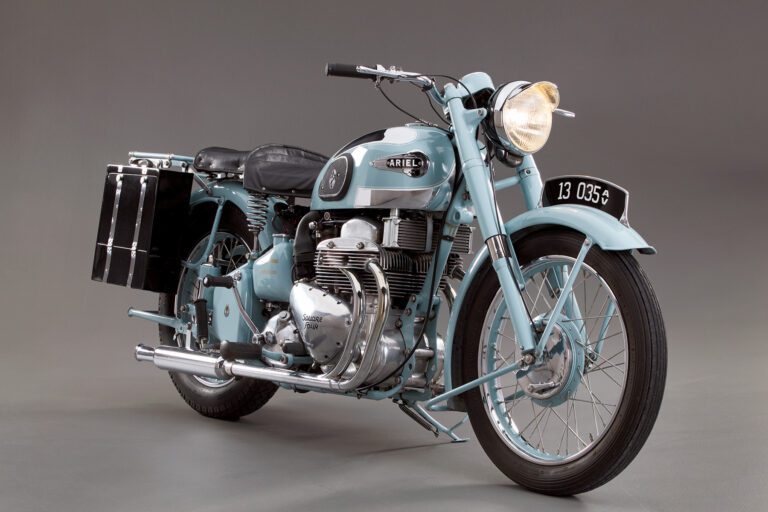
1953 Ariel 4G MKII Square Four
- Claimed power: 45 hp @ 5,500 rpm
- Top speed: 100 mph
- Engine: 997cc air-cooled OHV “square” four, 65mm x 75mm bore and stroke, 7.2:1 compression ratio
- Weight: 425 lb.
- Fuel Capacity/MPG: 6 ga. (22.7 ltr.)
- Price then/now: $950 (est.)/$15,000-$25,000

Ariel Square Four owners are used to being quizzed about the unique cylinder arrangement enjoyed by their air-cooled engines, the question most often posed being, “Don’t the rear cylinders overheat?” Savvy “Squariel” owners are ready with the answer. “Yes, but when they do that, we put them on the front …”
Although the limitations of Edward Turner’s compact power unit were recognized fairly early on in its life, it was still good enough to remain in production for 28 years, longer than many more famous designs. When Ariel owner BSA Group pulled the plug in 1959, the Square Four had become a rather portly touring machine that, though still capable of relatively high speeds, was being outclassed in the performance and handling stakes by newer British 650cc twins. But it wasn’t always that way. Like many touring bikes (Honda’s Gold Wing comes to mind), the original Square Four was designed with performance in mind.
Page and Turner
In 1928, Edward Turner was a motorcycle dealer in Peckham, London, with a dream of manufacturing bikes of his own. He had already designed and built two versions of the 500cc single-cylinder “Turner Special,” the first with a gear-driven overhead camshaft and the second using a vertical bevel-drive shaft and face cam to operate the valves.

In his attempts to find a manufacturer among Britain’s bike makers, Turner fetched up at the offices of Ariel Works Limited in Birmingham, where, instead of taking on Turner’s special, they offered him a job in the design department working under Valentine Page. What had impressed Ariel boss Jack Sangster was Turner’s second design, a unique 4-cylinder sketched out, goes the legend, on the back of a pack of cigarettes. (It’s likely Turner had already produced engineering drawings, but the smoke-pack story has stuck.)
Turner’s creation bristled with fresh ideas and ingenuity. The 4-cylinder 500cc engine used two crankshafts connected by helical gears with a chain-driven overhead camshaft. The cranks were transversely mounted, with one set in front of the other and each crankshaft driving a set of two pistons. The pistons were literally in a “Square Four” arrangement. The rear crankshaft’s helical gear also transferred power to the integral 3-speed transmission.

The only support for each crankshaft was a pair of bearings, one on either side of the central helical gear, meaning the flywheels and cranks “overhung” the main bearings. This made for a compact power unit, although the crankshafts later proved prone to flexing. Oil was stored in an integral reservoir in the back of the crankcase, which was split horizontally — a major break from established British practice. The cast iron cylinder block was topped with an iron cylinder head, with a single Amal carburetor mounted on the front feeding the cylinders via a cruciform manifold.
Turner’s first job at Ariel was to get the Square Four into production as soon as possible, and two prototypes quickly followed, with the compact power unit “persuaded” into the frame and running gear of a production Ariel 250. The resulting machine proved capable of 90mph speeds, yet weighed less than 300 pounds.
But by the time the Square Four was due for production, the financial collapse of 1929 had initiated the Great Depression, and Sangster demanded changes to make the Square Four easier and cheaper to produce. The engine would have to be modified to accept a separate, off-the-shelf Burman gearbox (requiring an extra flywheel and main bearing for the rear crankshaft) and the power unit would be fitted into the frame and running gear of the Ariel SG31 500cc “sloper” single. The resulting 4F/31 model displayed at the Earls Court motorcycle show in London in 1930 was considerably heavier and slower than the prototype.

It’s interesting to speculate whether Turner’s original overhead cam, 500cc design would have succeeded, but the Square Four moved in a different direction. To cope with the extra weight, engine capacity was increased to 601cc by increasing the bore from 51mm to 56mm for the Model 4F6 of 1932. Meanwhile, the Depression had caught up with Ariel’s parent company, Components Ltd., which went into bankruptcy in September 1932. The always canny Sangster then acquired Ariel as well as many other company assets at rock-bottom prices, and Ariel was soon back in production. Turner, now installed as chief designer (Page having left for Triumph), revamped the Square Four again for 1933 with straight-cut coupling gears, improved lubrication and a slight bore reduction giving 599cc, shedding 25 pounds in the process.
The next major revamp was in 1935. Turner completely redesigned the engine with conventional one-piece crankshafts coupled by gears carried outside the now vertically split crankcase. Connecting rods made of light alloy instead of steel ran on plain bearings instead of rollers, and the camshaft moved from the cylinder head to a new location between the crankshafts, operating the overhead valves by pushrods. Capacity was increased significantly to 997cc with 65mm x 75mm bore and stroke. The new 4G went on sale in 1936.
The postwar Square Four
After the break for “local difficulties,” Ariel was soon back in production with the 4G much as it had been, though the company was now owned by BSA. For 1947, Ariel added a telescopic front fork to replace the prewar girder type and optional “plunger” rear suspension incorporating an extra link. Designed in 1939 by Frank Anstey, the Anstey link was intended to maintain constant chain tension by allowing the wheel spindle to move through an arc, but also added an extra level of complexity, with several extra wear points over “regular” plunger designs. This design required fastidious lubrication via a multitude of grease nipples. Ignoring this routine led to rapid wear, letting the rear wheel twist from side to side, which certainly didn’t improve handling.

1949 brought major improvements, with both the cylinder block and head cast in light alloy instead of iron, and the magneto dropped in favor of battery/coil ignition. Many consider the 1949 “two piper” — with its chrome gas tank and wheel rims both trimmed with red paint — to be the best-looking Square Four. No doubt the alloy engine contributed to better cooling, which could have allowed higher power outputs. Nevertheless, the Square Four was never listed at more than 45 horsepower.
The 4G’s final upgrade came in 1953 with the introduction of the MkII, featuring a new cylinder head with four separate exhaust headers. The “Squariel” (a term coined by Dennis May writing as “Cyclops” in the magazine Motor Cycling in 1930) continued mostly unchanged until production was cancelled in 1959.
There’s just one footnote to the story: Many Ariel aficionados have wondered why the company persevered with the Anstey link suspension when most of the Ariel range switched over to swinging arm rear suspension in 1954. Ariel certainly built a swingarm prototype, but it was never adopted for production. Why? Perhaps the answer is in the numbers: With fewer than 4,000 4G MkIIs built over the years 1953-1959, it’s likely Ariel realized the model’s days were numbered, meaning a limited return on such an investment.
Joe Block’s Ariel Square Four
“I’ve been into motorcycling pretty much my whole life,” says Skokie, Ill., bike enthusiast Joe Block. In the late 1970s, Joe spotted a small ad for an Ariel in the Chicago Tribune. Although he knew little about older bikes at the time, he knew what a Square Four was, so he bought it. “The Ariel was my first old motorcycle, and my very first classic bike,” Joe says.
The 1953 Square Four was only on its second owner when Joe bought it, and it was pretty much original. “I used it for years, and it ran pretty well,” Joe says.

Joe’s interest in vintage bikes mushroomed, and one night in the mid-1980s, while returning with a friend from a Vincent Club meeting in Chicago (“I was a hanger on”), the Square Four suffered a major mishap. “We came back late at night,” Joe recalls, “and while we were riding my primary chain broke and cracked open the primary case.”
The broken Ariel languished, but a few years later, preparing to attend a British Biker Cooperative rally in Wisconsin, Joe decided it was time to revive the Ariel. “All my Vincent buddies were going,” he says, adding, “I didn’t even really properly patch up the primary. We got into a little bit of a high speed run and I blew a head gasket halfway up. That kind of bummed me out. I found a guy with a pickup truck and he drove me back home.”

After that experience, Joe decided it was time to get the Ariel properly restored, especially because of its significance in the history of the model, and he decided to paint it Wedgwood Blue instead of its original black. “The 1953 was the first year of the four-piper, and the only year they did Wedgwood Blue. It was a factory option in honor of the Queen’s coronation,” he says. That would be Queen Elizabeth II, and Ariel also offered the Wedgwood Blue color option on its large singles and twins.
Ariel restoration
Though a competent mechanic, Joe didn’t want to tackle the job himself and decided he should hand the work to a professional. After some correspondence he settled on Robin James Engineering Services and shipped the bike off to the U.K. in 2000. The restoration took until 2007!
“The time period didn’t really bother me too much,” Joe says, “because being spread out over so much time, it never really cost me too much at one time. I didn’t really want a concours restoration. I wanted a practical rider with some upgrades, so we used a lot of stainless fasteners, and we also upgraded it to electronic ignition; the distributor is sort of fake. It took a bit of fettling because nobody makes an actual kit for a Square Four.”
Based on his experience, Robin James insisted on installing a high-capacity oil pump with an oil cooler to tackle the Square Four’s known overheating issues. “For the amount of money I spent, there were a few things I could have quibbled about, but overall it’s a gorgeous machine,” Joe says, adding, “It runs well, and I use it. Since the restoration, I’ve put between 2,000-3,000 miles on the machine. I’ve never really taken any major tours on it, but it runs really well.”
What about the Square Four’s famous overheating issue? “I think with the four-pipes it’s a little overstated. Even on 70-80 degree Fahrenheit days, it doesn’t really run very hot. The oil cooler may be a little bit of overkill and not really necessary. The early MkIIs still had the smaller oil tank, and I always worry a little bit about that,” he says, adding, “But the oil always looks good when I change it out.”

A minor issue of contention among 1953 Square Four owners is whether the stock Lucas headlamp shell should be painted Wedgwood Blue or not. “We concluded — and Roy Bacon says in his book — that the headlight shell was not painted,” Joe says. “It would have been a proprietary Lucas item, and it would not have been painted at the factory. But most of the photos of Ariel Square Fours I’ve seen that are in Wedgwood Blue usually have the shell painted. To this day I’m really not 100 percent sure.”
When it comes time to ride, Joe likes the Ariel. “It has great low-down torque, great grunt, so you don’t really need to shift the gears. You can be down to 10-15mph in top gear and slowly pull away, which I really like. It’s not by any stretch of the imagination a sports machine.
“There’s absolutely no doubt that the suspension is not really designed for sporty handling. With that plunger and Anstey link rear suspension you get a pretty wallowy feel, especially going through curves with bumps in them. But it’s fine for the speeds I ride it at. I rarely have it over 70-75mph. It will pull close to the ton, but I have no reason to push it. Most of my riding is done in the 50-60mph range,” he says.
Any tips for potential Ariel Square Four owners? “Lubricate, lubricate, lubricate!” Joe says. “Get a copy of the original instruction book. There are a lot of lubrication points on it. That Anstey rear suspension wears very quickly because there are a lot of parts that are rubbing against each other.” His final bit of advice? “And ride it!” MC