1989-1993 Buell RS1200
- Years produced: 1989-93
- Total production: 200 (est.)
- Top speed: 120mph (est.)
- Claimed power: 70hp (est.)
- Engine type: 1,200cc air-cooled, 45-degree V-twin
- Weight (wet): 210kg (462lb)
- Price then: $14,795
- Price now: $8,000-$12,000
- MPG: 42
Sometimes people can be a little bit too clever for their own good. Back in the 1980s, a little-known former racer, musician and Harley-Davidson engineer named Erik Buell decided to build what his T-shirt slogan described as “America’s Faaast Motorcycle” around a Harley engine: He left no stone unturned in the search for speed.
After designing a neat, compact, lightweight and extremely clever chassis to hold the big V-twin, Buell finished the job in the most logical way possible: with all-enveloping bodywork that held the lone rider in a perfect tuck, gave the moving bike a supremely aerodynamic shape, and provided maximum speed from the horsepower at his disposal.
One problem: you couldn’t tell that its engine was a Harley. No matter that Buell painted his creation in Milwaukee orange, black and white, and wrote “Powered by Harley-Davidson” on its bulbous flanks. With its uniquely evocative engine hidden away, the Buell Battletwin looked like a cross between a Honda CBR1000F and a brightly decorated Easter egg.
That did not stop the first Buell from being a success, originally as the RR1000 and then — after Buell had negotiated with his former employers for supplies of Evolution Sportster engines — as the RR1200. The bikes created interest as roadsters and did well on the racetrack, too. Production of the RR crept steadily towards three figures.
A new tact: The RS1200
It was in 1989 that Buell released a distinctly different and arguably more significant model: the RS1200. From one viewpoint, the half-faired, dual-seated RS was less outstanding than the RR, having lost the single-minded devotion to speed that was the characteristic of the original Buell. One step backwards, perhaps, but two steps forward as a result. And this time, there was absolutely no need to note, even on bodywork finished in anonymous blue, that Harley-Davidson powered the Buell RS1200.

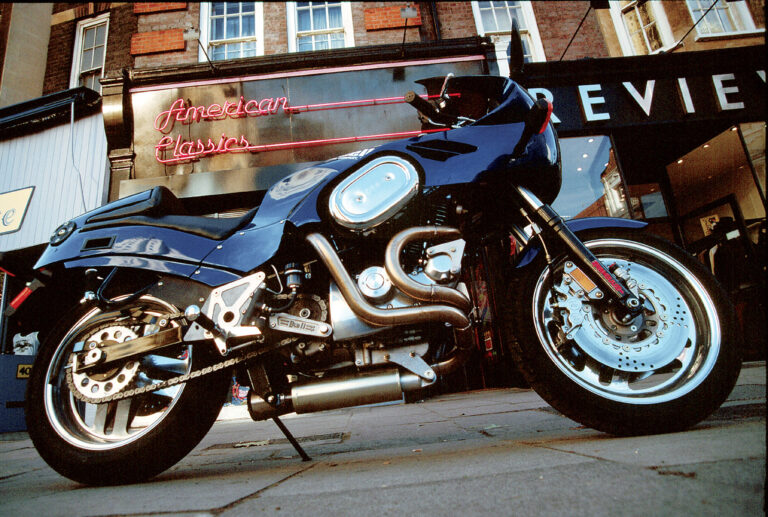
The RS1200’s big lump of twin-cylindered Milwaukee metal hung out for inspection, and even if the powerplant still wasn’t completely visible, there was no doubt at all as to this Buell’s motive power. The dramatic facelift had other advantages, too, because it had always been a shame that so much of Erik Buell’s clever engineering had been buried — along with the engine — behind fiberglass.
But with the arrival of the RS1200, almost all was revealed: the lattice-style steel frame with its unique, Buell-designed rubber-mounting system; the horizontal rear shock beneath the engine; and the stubby Supertrapp muffler running alongside the shock. Even the Buell-designed front wheel and the man’s own four-pot brake calipers, largely hidden by the RR’s wind-cheating front fender, were on show to the world.
Yet the character of the bike had not been lost by the changes. The basic shape of the half-fairing, tank and seat unit remained, the various parts running smoothly into each other and held together by a succession of cross-headed screws. Finish was good, with neat kneepads in place on the fairing. The RS’s riding position was a little more upright than the RR’s, and far more flexible. Higher clip-on bars and new footpegs gave a roomier ride than the head-down racer, which had often been criticized for not quite fitting anyone just right.
On the road today
Crucially, the brute has an unmistakably Harley feel when I fire it up. Turn the ignition on with the key in the right of the fairing, followed by a dab of choke with the lever on the opposite side, then press the starter button and the big engine shakes lazily to life with a hollow “thrapp” from the Supertrapp. At low speeds the engine jumps around a bit on its mounts, but as the revs rise it smoothes magically like no other Sportster lump alive. There is torque from rock bottom: Given a touch of throttle, the Buell gallops away, its engine feeling amazingly sweet.
The RS1200 is a very short bike, but despite a lowish seat (29.5in), it feels quite tall and less low-slung than a typical Harley. It is quite maneuverable at low speeds, though, flicking through traffic with ease, the only complaints coming from my thumbs: the stock H-D switchgear means the indicators need to be held on at all times to make them work, and the less-than-generous steering lock traps my pinkies against the tank on either side.

Who cares, though, when the bike chuffs and coughs and rumbles along as evocatively as this one, yet still idles at a rock-steady 1,000rpm? The powerplant is equally impressive at higher speeds, where the curvy screen keeps the wind off my body, if not my head. (You’d have to squint through the black Perspex screen to avoid the wind completely.) On the open road the long-legged lump thrusts the bike forward with incredible smoothness, snicking easily up and down the four-speed gearbox and pulling crisply from 1,500rpm without the slightest hint of a power step.
The Buell came with a standard Sportster engine, and even the bigger version of the basic late-Eighties pushrod twin was by no means a horsepower hero. With only about 70hp to call on despite a slight gain from the two-into-one pipe (tuneable by adding or removing baffle plates in its end), the racy-looking Buell starts running out of breath at much over 100mph, on the way to a top speed of about 120mph.

Mind you, the engine could easily be livened up with aftermarket parts. For real go, the hot set-up included twin-plug heads and a Branch Flowmetrics porting job, a camshaft set, and replacing the stock CV carburetor with something by Mikuni or Screamin’ Eagle. The price was high, but the result was a ball-busting final output of around 95hp.
Alternatively, the RS rider could just try and catch ’em in the corners. The compact Buell chassis really is remarkable, combining a Ducati-esque steel ladder frame with Erik B’s unique engine-mounting system, and a suspension set-up that was almost as weird but — on this evidence — not yet quite as wonderful.
Buell’s “Uniplanar” set-up joined engine to frame via rubber mounts in three points, and it had one big advantage over Harley’s contemporary anti-vibe system. Instead of the rubber allowing the engine to dance in all directions, Buell used four adjustable ball-ended rods, each bolted to engine and frame, to restrict the V-twin’s leapings to the vertical plane only. The result added engine stiffness to the trellis without passing vibration to the rider.

Other parts show Buell’s determination to get things right in his own way. Forks are 42mm Marzocchi M1R units plumbed with Buell’s Harley-style Air Control Technology (ACT) anti-dive system. This uses solenoid valves, operated by the front brake lever, to cut the forks’ air volume, effectively increasing the springs’ rising-rate just when it is most needed.
At the back, a rather puny-looking steel swing arm operates a Works Performance shock which, as there was no room for it to stand behind the huge engine in such a tiny bike, lays horizontally beneath the engine. The shock body is enclosed to keep out road grime, and the unit extends over bumps, compressing its spring via two bolts running down its length.
Brakes and wheels, too, were Buell’s own design. Wheels are polished aluminum 17-inchers running fat Dunlop Elite tires. Brakes followed racebike trend, being massive at the front but miniscule at the back: four-piston calipers clamp twin 310mm rotors at the front, while a two-pot caliper brushing a single 230mm disc works the rear.
The effect of all this is much as expected. Grab a handful of front brake and the little 450lb bike attempts to loop the loop as it digs a trench with its front Dunlop. The stopper is as controllable as it is powerful, though, and gives heaps of feel at the standard Harley lever. The rear brake was intentionally more like a stock H-D front item — virtually undetectable — and could therefore usefully be used to slow the bike gently without risk of locking-up.

There isn’t much wrong with the forks, either. The stout Marzocchis, variable for air pressure as well as having a four- way compression damping adjuster on the right leg, give a mix of firmness, comfort and control under braking that is just about right. Rear suspension is less impressive, though, lacking the rebound damping to keep a stiff spring under control. Over bumps the bike jolts harshly. And even in smooth bends the Buell’s back end pogos slightly as the shock fails to cope. At least the steep steering geometry gives lightning-quick changes of direction, even at speed. A steering damper lurks inside the fairing’s lower left side, just in case.
Hitting the mark
In its day, all this innovation added up to a very impressive motorcycle, and there was still one more piece of design genius worthy of note: the seat hump. Buell’s latest Ulysses dual-purpose bike has a similar feature, and it was first seen on the RS1200. A youthful Erik Buell, it appears, once wheelied a girl off the back of a bike he was showing-off on, and decided to devise something that would stop this happening in the future.
The RS’s seat hump achieved its aim brilliantly, swinging up (after a locating pin has been unscrewed) to become a backrest when needed. At the same time it solved the problem of what to do with a normal detachable tailpiece, and also gave permanent storage space for a thin set of raingear or similar. The execution could perhaps have been a little tidier — when folded back down for solo use the hump is a bit ugly — but the concept was undeniably clever.
There’s that word clever again. And if any motorcycle designer deserved the description it was the youthful engineer from Mukwonago, Wis. Back in 1989, Erik Buell and his team of 12 built four bikes a week, the majority of them the RS. His original RR racer had perhaps been more typical of the man: superbly designed and crafted, and ruthlessly single-minded in its search for the holy grail of speed.
But it was with the RS1200 that Buell really hit the mark. The RS1200 was expensive, as any small-volume bike is bound to be. It had a few rough edges, and didn’t sell in great numbers. But the RS was an inspired, superbly professional attempt at building a true Harley-Davidson sports bike. It will long be remembered as the machine that laid the foundations for Buell Motorcycles’ success in subsequent years. MC